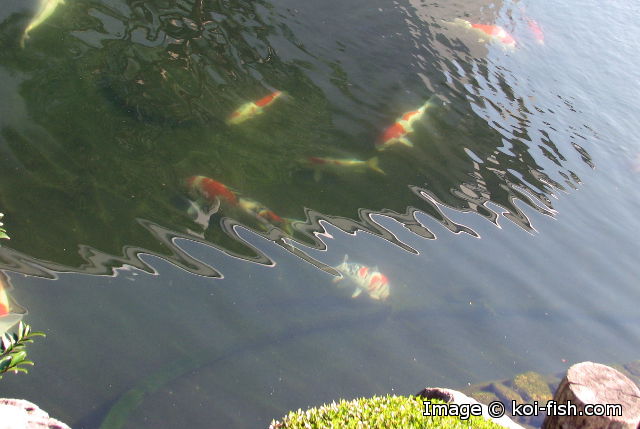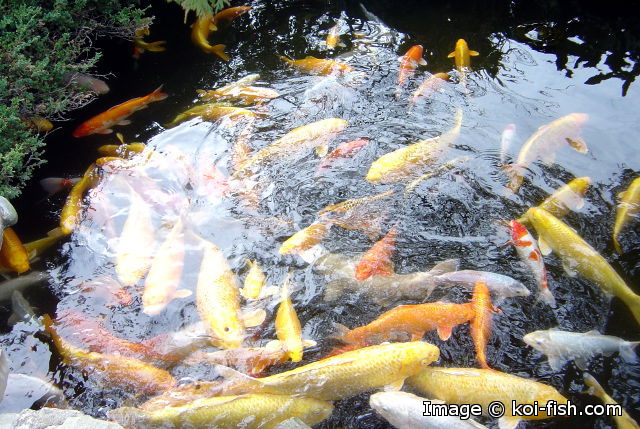
Koi need a large, well-filtered pond, clean and oxygen-rich water, appropriate feeding, and enough space to grow. For beginners, the most important things to get right are pond size, filtration, water quality, stocking density, and seasonal feeding. This koi fish care guide walks through those essentials so you can keep your koi healthy from the start.
Koi Care at a Glance
| Need | Beginner guideline |
|---|---|
| Habitat | A large outdoor pond with stable water conditions |
| Pond depth | At least 3 feet deep in most situations |
| Water quality | Keep ammonia and nitrite at 0 ppm and maintain a stable pH |
| Filtration | Use effective mechanical and biological filtration |
| Aeration | Provide strong aeration, especially during warm weather |
| Feeding | Feed according to water temperature and avoid overfeeding |
| Stocking | Avoid overcrowding and allow room for koi to grow |
| New fish | Quarantine new koi before adding them to the main pond |
| Daily routine | Watch appetite, swimming, breathing, and behavior for changes |
Contents
- How Big of a Pond Do Koi Need?
- Koi Pond Filtration and Aeration
- Koi Water Quality for Beginners
- What and How Often to Feed Koi
- How Many Koi Can You Keep?
- How to Choose and Buy Healthy Koi
- Quarantining New Koi
- Signs of Healthy vs. Sick Koi
- Seasonal Koi Care
- Beginner Koi-Keeping Mistakes to Avoid
- A Short History of Koi Keeping
- Sources
- Further Reading
How Big of a Pond Do Koi Need?
Koi need more room than many first-time pond owners expect. They are active fish that can grow quite large, so a small decorative pond can quickly become overcrowded.
Koi thrive in a stable environment. Large temperature fluctuations can happen quickly in shallow water, so a koi pond should generally be at least 3 feet deep. Deeper water also gives koi more room to swim and can make the pond environment more stable.
Steep pond edges can also help discourage predators such as herons and raccoons from wading into the pond.
Koi Pond Filtration and Aeration
Koi keepers often focus heavily on water quality and filtration for good reason. Most backyard koi ponds are too small to be self-sustaining, so they need a filtration system that continuously removes fish waste and other debris before it can harm the koi.
A good pond filter combines mechanical filtration, which removes solid waste, with biological filtration, which supports beneficial bacteria that process dissolved fish waste.3
Aeration is also important. Moving, oxygen-rich water supports both the koi and the beneficial bacteria in the filter. Extra aeration can be especially valuable during warm weather, when water naturally holds less dissolved oxygen.
Koi Water Quality for Beginners
Healthy koi depend on stable water conditions. Beginners should regularly test the pond for ammonia, nitrite, nitrate, and pH. Ammonia and nitrite should remain at 0 ppm in an established pond.
Sudden changes in water quality are often more stressful than small differences in a single reading. Test regularly, avoid large swings in pH or temperature, and investigate quickly if your koi suddenly stop eating, gasp near the surface, clamp their fins, or behave differently.
Learn more in our guide to the pond nitrogen cycle.
What and How Often to Feed Koi
Koi are commonly fed once or twice a day during suitable water temperatures. Give only as much food as they can comfortably eat within a few minutes. Overfeeding creates excess waste, which can quickly reduce water quality.
Koi have different feeding needs throughout the year, so feeding should change with water temperature and season rather than following the same routine every month.
See our seasonal koi feeding guide for a more detailed schedule.
How Many Koi Can You Keep?
One of the most common beginner mistakes is adding too many koi too quickly. Small koi may look comfortable at first, but they grow, eat more, and produce much more waste as they mature.
Stocking density should be based on the pond's water volume, filtration capacity, aeration, and the adult size of the fish. Leave room for growth instead of stocking the pond to its limit from the beginning.
Read more about understanding koi stocking density.
How to Choose and Buy Healthy Koi
Koi can be found at big-box retailers, pet stores, garden and landscape centers, domestic koi farms, and specialty koi dealers. The quality of the fish and the conditions in which they are kept can vary greatly.
When choosing koi, look for fish that are alert, swimming normally, breathing steadily, and free of visible sores, damaged fins, fuzzy growths, or abnormal swelling. Avoid tanks where multiple fish appear lethargic or distressed.
Specialty koi shops and experienced koi farms are often better equipped to maintain appropriate water quality and quarantine practices, especially for higher-grade fish.

Quarantining New Koi
Always quarantine new fish before adding them to your main pond. A quarantine period gives you time to observe the new koi for signs of disease or parasites without exposing your established fish.
Keep quarantine equipment separate from the main pond whenever possible, and watch new koi closely for appetite, breathing, swimming behavior, and visible skin or fin problems.
Signs of Healthy vs. Sick Koi
Healthy koi are generally alert, active, interested in food, and able to swim without difficulty. Their fins should normally be held open, their breathing should be steady, and their skin and scales should appear smooth and intact.
Warning signs include sudden loss of appetite, clamped fins, gasping, flashing or rubbing, isolation from the group, sores, fuzzy patches, unusual redness, swelling, or abnormal swimming.
If something looks wrong, check the pond water first. Poor water quality can cause stress and can make koi more susceptible to disease.
For a step-by-step inspection, see how to perform a koi health check.
Seasonal Koi Care
Koi care changes throughout the year. During warm weather they are more active, eat more, and place a greater load on the pond's filtration and oxygen supply. As water temperatures fall, their metabolism slows and feeding should be reduced.
Seasonal maintenance should include adjusting feeding, checking aeration, cleaning filtration as needed, removing excess debris, and watching for rapid changes in temperature or water quality.
10 Beginner Koi-Keeping Mistakes to Avoid
- Starting with a pond that is too small or too shallow.
- Adding too many koi before the filter can support them.
- Overfeeding.
- Ignoring ammonia, nitrite, and pH testing.
- Using inadequate biological filtration.
- Providing too little aeration.
- Adding new koi without quarantine.
- Handling or netting koi unnecessarily.
- Making sudden large changes to pond water conditions.
- Waiting too long to investigate unusual behavior or loss of appetite.
A Short History of Koi Keeping
In Niigata, Japan, heavy winter snowfall often left rice farmers in mountainous areas isolated for extended periods. Carp (Magoi) were kept as a source of food and were also useful to agriculture because nutrient-rich pond water could fertilize rice fields.
Some of these carp developed patches of red color. Around the beginning of the 19th century, farmers began selectively breeding unusual colored carp to strengthen and refine those traits.1
Over time, koi keeping spread across Japan. Early koi were transported in wooden containers, long before modern oxygen systems and plastic shipping bags improved survival during transport.2
International koi keeping expanded rapidly in the 20th century as modern transportation and fish-shipping methods made it practical to move koi safely around the world.

The Koi-Keeping Hobby
Many experienced hobbyists join local koi clubs. These clubs can be a useful source of practical information, and members often meet regularly to discuss koi care, ponds, filtration, health, and new developments in the hobby.
Some clubs also host annual koi shows. Fish are typically grouped by variety and size and judged on characteristics such as body conformation, skin quality, pattern, and color. Major shows may award an overall grand champion.

Basic Koi Care Routine
Koi require relatively little direct handling, but their pond needs consistent maintenance. A well-designed filtration system can greatly reduce routine cleaning, while an undersized or poorly designed system often creates more work and less stable water quality.
Avoid unnecessary netting or handling. Repeated handling can stress koi and may make them more vulnerable to health problems.

Sources
- Balon, Eugene K. "The common carp, Cyprinus carpio: its wild origin, domestication in aquaculture, and selection as colored nishikigoi." (1995).
- Takeda, Kaz. “History of Niigata Nishikigoi.”
- Axelrod, Herbert R. “The Completely Illustrated Guide to Koi for Your Pond.” TFH, (1996).
Further Reading
- Koi Care
- Koi Health
- Understanding the Pond Nitrogen Cycle
- Seasonal Koi Feeding Guide
- Understanding Koi Stocking Density
- How to Perform a Koi Health Check
- AKCA website
- ZNA English website