
A study published online on September 7, 2026, reported gill damage in common carp experimentally exposed to polystyrene microplastics and a flame-retardant chemical. For koi keepers, the connection is direct: koi are ornamental varieties of common carp, Cyprinus carpio.
The timely question is what this research should change beside a backyard pond. It does not establish that your liner, filter media or pipework is harming your fish. It does make this a useful moment to inspect deteriorating materials and follow where the debris from pond maintenance actually goes.
The practical takeaway: look for an identifiable source, a route into the water and a way to remove captured waste. That approach gives you something useful to do without dismantling the filtration your koi depend on.
What the new carp research found—and what remains unknown
The study in Aquatic Toxicology examined polystyrene and triphenyl phosphate, or TPHP, separately and together, after three and seven days. Effects included impaired gill barriers, inflammation and disrupted energy metabolism. Combined exposure produced the most extensive gene-expression changes despite lower TPHP accumulation in gills than with TPHP alone.
This was not a backyard-pond survey or commercial equipment test. The accessible abstract lacks sufficient exposure detail for comparison with your pond. It cannot establish a household-pond safety threshold.
Keep that boundary in mind when reading alarming headlines. A laboratory finding can justify investigating an exposure without telling us how frequently that exposure causes illness in real koi ponds.
Why the connection to koi goes beyond swallowed plastic
A koi pond continually moves water past fish and through equipment. Much of our maintenance focuses on what koi eat and what their waste does to water quality. This research directs attention to the gills, which are also an important interface between a fish and its surroundings.
Another relevant piece of evidence comes from a 2025 field study of spawning common carp. Researchers investigated how sediment disturbance affected plastic particles in lake surface water and found that carp activity could resuspend microplastics and microfibers. A lake containing spawning carp is different from a filtered garden pond. Still, the study highlights a useful management question: where does settled debris go when something disturbs it?
For your pond, apply that question to bottom deposits, settlement chambers and filter cleaning. Material that has settled out of view has not necessarily left the system. This is a practical interpretation of the research, not a measured estimate of exposure in domestic koi ponds.
A useful inspection starts with condition, not a plastic-free shopping list
NOAA explains that microplastics include small particles created as larger plastic objects break apart, including during use. Weathering and physical wear therefore deserve attention. The presence of a plastic object alone tells you much less than its condition and whether fragments can reach the pond.
We suggest the following inspection as a maintenance aid. It is not a laboratory test or a validated microplastic risk score. Examine removable items away from the water, without scraping, grinding or deliberately breaking them.
| Location | What to look for | Useful response |
|---|---|---|
| Netting and covers above the pond | Broken strands, frayed edges or pieces separating during ordinary handling | Replace damaged material carefully; collect loose pieces before removing the cover. |
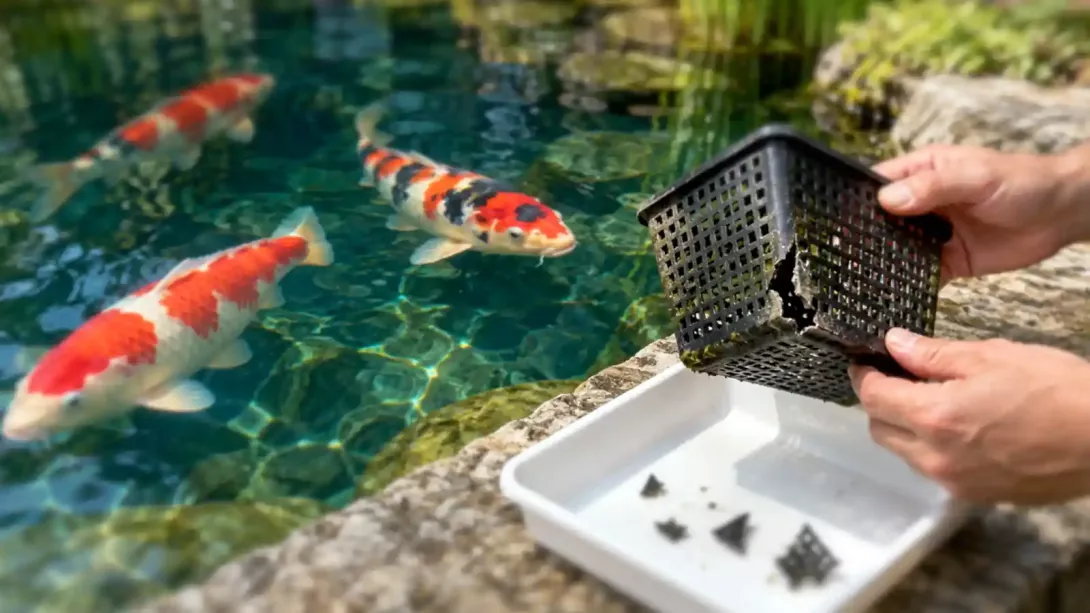
| Plant baskets and removable decorations | Cracked edges, flaking surfaces or crumbling components | Lift the item into a tray before inspection so loose debris stays out of the pond. |
| Hoses and exposed fittings | Cracks, abrasion, leaks or visible material loss | Repair or replace the failing component with one suitable for its pond application. |
| Mechanical filter pads and brushes | Persistent loss of fibers or pieces during normal maintenance | Check the manufacturer's replacement guidance and inspect where the shed material travels. |
| The surrounding work area | Cable-tie ends, packaging, synthetic string or plastic shavings | Collect debris before wind, washing or rainfall carries it toward the water. |
These are plausible places to investigate, not a claim that every item listed is releasing harmful quantities. An intact basket and a basket that crumbles when lifted require different decisions.
Give priority to an item visibly losing material directly over the water. Photograph its condition, note where fragments appeared and keep the product details. If unexplained shedding continues, that record makes a manufacturer inquiry more useful than a general question about whether “plastic is safe.”
Follow the waste all the way out of the system
Here is a distinction worth saving: a filter catching a particle and a keeper removing that particle are separate events.
Imagine a mechanical pad collecting visible fragments. If the pad is rinsed in a bucket and the dirty water is poured into the pond, those captured fragments have simply made a round trip. The same applies when debris is washed from a filter chamber into a return channel.
During your next service, follow one complete cleaning cycle:
- Identify which part of the system collects solid waste.
- Check whether cleaning sends that waste outside the recirculating loop.
- Keep collected solids and dirty rinse water from flowing back into the pond.
- Capture loose plastic pieces for appropriate disposal; keep them out of storm drains and natural waterways.
- Restore the equipment correctly and verify normal water flow.
This does not establish how many microscopic particles your filter captures. It fixes an observable maintenance problem without requiring that information. Our koi pond filtration guide explains the different jobs performed by mechanical and biological filtration.
Protect the biofilter while making changes
Concern about microplastics is not a good reason to remove all established biological media at once. University of Florida guidance on ammonia explains that nitrifying bacteria process fish waste and depend on oxygen and alkalinity. Disrupting that treatment system can create an immediate, measurable water-quality problem.
If biological media is physically failing, plan replacement with the supplier or a qualified pond professional. Preserve adequate functioning filtration during the transition and monitor ammonia and nitrite closely. The appropriate method depends on how your system is built.
Replacing a damaged removable ornament is a different job from replacing the surfaces supporting your nitrogen cycle. Use our guide to the pond nitrogen cycle before making major filtration changes.
Likewise, avoid improvising an extremely fine filter that restricts circulation. Ask for performance information covering particle sizes, operating flow and cleaning requirements. A claim that a product “removes microplastics” is incomplete unless you know what was tested and under which conditions.
Clear water cannot answer the microplastics question
You cannot establish a pond's microplastic concentration by looking into a glass of water. Tiny visible specks might be mineral particles, plant material or something else. Conversely, apparently clear water does not prove that small plastic particles are absent.
The EPA describes substantial measurement challenges, including distinguishing plastics from other particles and contamination introduced by sampling equipment itself. Many identification methods require laboratory preparation and analysis.
If you commission testing, ask the laboratory which particle sizes and polymers its method can identify, how samples should be collected and how contamination is controlled. A result has to be interpreted within those limits. A particle count alone is not a diagnosis of illness in your koi.
Warning signs: investigate the fish without guessing the cause
Gasping, rapid gill movement, repeated flashing, appetite loss or unusual lethargy deserve attention. None specifically identifies microplastic exposure.
Start with the conditions you can assess promptly: aeration, pump operation, temperature, ammonia, nitrite, pH and recent changes. Check for an interrupted water supply, untreated replacement water, runoff or a treatment mistake. Our water-quality troubleshooting guide provides a starting sequence.
UF/IFAS guidance on dissolved oxygen identifies surface gulping as a warning of oxygen trouble. If fish are struggling to breathe, promptly restore or increase appropriate aeration and seek help; do not postpone immediate care while investigating microscopic particles.
Persistent distress, injuries or deaths warrant an aquatic veterinarian. Record symptoms, test results, equipment changes and recent chemical use. The koi health guide can help organize observations, but it cannot replace a diagnosis.
Four mistakes this research should not trigger
- Assuming every polymer has the same effects. Results involving polystyrene and a particular chemical mixture cannot automatically be transferred to every liner, pipe or filter medium.
- Buying an unproven pond “detox.” A product needs evidence for its actual claims and suitability for fish, plants and filtration.
- Scrubbing damaged materials over the water. Move removable items into a contained work area before dealing with loose debris.
- Letting an emerging concern displace routine care. Keep feeding, oxygen, water testing and waste removal under control while investigating material deterioration.
What to do at your next pond service
Inspect materials for visible failure, remove loose debris and verify that filter waste actually leaves the pond system. Preserve effective biological filtration and keep a record of anything unusual.
The new carp study gives koi keepers a reason to pay attention. The useful response is a more careful maintenance routine, guided by what you can observe and measure, while research works toward clearer answers about real-world exposure.