
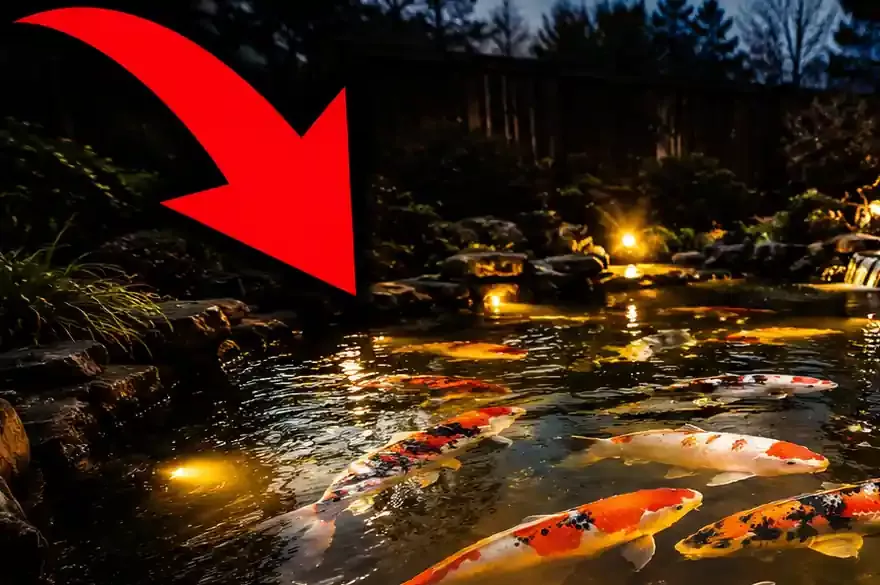
Beautiful water can still contain a serious problem. In a koi pond, the investigation begins by distinguishing ordinary waste and filtration trouble from sewage, pesticide, fuel or other chemical contamination. Those situations need different responses.
If hazardous contamination is suspected, keep people and pets away from the water and contact qualified fish-health and appropriate local environmental help promptly. Routine pond tests do not establish that contaminated water is safe.
What a Contamination Warning Means
A sewage spill is dramatic because everyone instantly understands that sewage and water recreation do not belong in the same sentence.
Nobody hears “sewage spill” and says, “Well, let’s give it a quick taste test.”
A public-water contamination warning is a reminder that appearance alone cannot establish safety. Backyard pond decisions likewise need evidence about the actual problem.
Now shrink that lesson down to your koi pond.
Suspected sewage or chemical entry is not an ordinary filter-cleaning job. Get advice specific to the substance and exposure before handling contaminated water, moving fish or choosing treatment.
But koi ponds can be contaminated in smaller, sneakier ways:
- Lawn fertilizer washing into the pond after rain
- Pesticide overspray drifting from the yard
- Leaves and plant debris rotting on the bottom
- Uneaten food breaking down in the water
- Fish waste overwhelming the filter
- Animal waste from birds, raccoons, dogs, or wildlife
- Dead algae decomposing after a bloom
- Dirty filter pads that have become sludge bricks
- Untreated tap water added during a top-off
- Runoff from mulch, soil, or landscaping beds
These are not equivalent hazards. Leaves and normal fish waste call for waste-management review; pesticide, sewage or fuel exposure may need a specialized response even when ordinary pond tests look normal.
Your koi do not care whether the contamination arrived in a breaking-news headline or slowly dripped in from the flower bed. They live in the water. They breathe through it. They eat in it. They sleep in it. They cannot step out, grab a towel, and say, “This pond has become disgusting. I’ll be in the house.”
If the water goes bad, the fish pay first.
Clear Water Is Not the Same as Clean Water
This is one of the biggest traps in koi keeping.
A pond can look clear and still have dangerous ammonia. It can look calm and still have low oxygen. It can look beautiful and still be one bad thunderstorm away from a fish emergency.
Clear water is nice. But clear water is not a water test.
Imagine looking at a glass of water and saying, “Well, it looks fine, so it must be safe.” That is not science. That is how horror movies begin.
Koi pond water quality depends on what is happening chemically and biologically inside the pond. The important stuff is often invisible:
- Ammonia
- Nitrite
- Nitrate
- pH
- KH/alkalinity
- Dissolved oxygen
- Temperature
- Organic waste load
Your eyes can spot algae, foam, sludge, and cloudy water. But your eyes cannot reliably detect ammonia or nitrite. By the time fish are flashing, gasping, clamping fins, or sitting on the bottom, the pond may already be in trouble.
Test the properties your kit measures, but understand its limits. Ammonia, nitrite and pH tests do not screen for every pesticide, fuel component or pathogen.
Koi owners should think the same way.
Waste Load and External Contamination
Let’s be honest: koi ponds are gorgeous, but they are also biological soup.
That is not an insult. That is literally how they work.
A healthy koi pond is full of fish, bacteria, algae, plants, insects, biofilm, decomposing organics, filtration, oxygen exchange, and constant waste processing. When everything is balanced, it works beautifully. The fish thrive. The water stays stable. The filter does its job. The pond looks alive in the best possible way.
A pond can exceed its capacity to process ordinary waste. That is a different mechanism from a toxic substance entering from outside, although either can harm fish.
Here are the usual suspects.
1. Overfeeding: The Buffet That Becomes a Biohazard
Koi are professional beggars. They will swim up to you with their adorable faces and act like they have not eaten since the invention of bread.
Do not believe them.
Every extra handful of food becomes either fish waste or rotting leftovers. Both add pressure to the filter. Both can contribute to ammonia problems. Both can make the pond dirtier than it looks.
If food is still floating around after a few minutes, you are not feeding fish. You are feeding the pond’s future sludge layer.
2. Fertilizer Runoff: The Lawn’s Problem Becomes the Pond’s Problem
That thick green lawn around the pond may look amazing, but fertilizer and pond water are not best friends.
Rain can wash nutrients from lawns and landscape beds into the pond. Those nutrients can fuel algae blooms. Then, when algae dies and decomposes, oxygen can drop. Suddenly your koi are dealing with the aquatic version of a party that got out of control and nobody cleaned up.
If your pond sits lower than the surrounding yard, runoff is even more dangerous. Water follows gravity. Unfortunately, gravity does not care about your koi collection.
3. Pesticides and Herbicides: The Invisible Pond Villains
Sprays used around lawns, weeds, shrubs, or patios can drift into pond water or wash in after rain. Even if you are careful, wind can move droplets farther than expected.
Your koi pond is not the place for chemical guesswork.
If you use lawn or garden treatments near a pond, read labels carefully and avoid overspray. Better yet, create a buffer zone around the pond where chemicals are not used.
4. Leaves and Sludge: Autumn’s Gift That Keeps Rotting
Leaves look harmless. One leaf is harmless. A few leaves are normal.
A thick layer of decaying leaves on the bottom of the pond is not harmless. It is a slow-motion waste bomb.
Decomposition consumes oxygen and can contribute to poor water quality. Remove reachable waste routinely, but do not churn a deep, foul-smelling accumulation into the pond. Stop if fish become distressed and arrange an experienced clean with suitable holding facilities when necessary.
5. Dirty Filters: When the Cleaning System Needs Cleaning
Your filter is supposed to remove waste, not become a museum of ancient pond goo.
Mechanical filters trap debris. If they are not cleaned, that trapped debris keeps breaking down inside the system. The water may still be moving, but it is moving through a disgusting sponge of regret.
Clean skimmer baskets. Rinse mechanical pads. Keep water flowing. But do not destroy your beneficial bacteria by blasting biological media with chlorinated tap water.
There is a difference between maintaining your filter and nuking your biofilter from orbit.
Signs Your Koi Pond Water Has Gone Bad
Koi cannot talk, but they are excellent at looking offended by poor water quality.
Watch for these warning signs:
- Gasping at the surface
- Hanging near waterfalls or air stones
- Clamped fins
- Flashing or rubbing against surfaces
- Sudden jumping
- Red streaks or irritated skin
- Lethargy or bottom-sitting
- Loss of appetite
- Foam that does not quickly disappear
- Cloudy water
- Rotten or swampy smell
- Sudden algae bloom
- Dead fish, snails, frogs, or insects around the pond
Some of these signs can also point to parasites, bacterial infections, or temperature stress. But water quality should always be one of the first things you check.
Why?
Because treating sick fish in bad water is like mopping the floor while the bathtub is still overflowing.
The Tests Every Koi Owner Should Have
If you own koi, a water test kit is not optional equipment. It is not a fancy accessory. It is not something only “serious people” need.
It is the dashboard for your pond.
You would not drive a car with no fuel gauge, no temperature gauge, and no warning lights while saying, “The hood looks shiny, so the engine is probably fine.”
Your pond needs the same respect.
Test for:
- Ammonia: aim for no detectable ammonia; interpret a result alongside temperature, pH, units and test method.
- Nitrite: aim for no detectable nitrite and investigate a positive result promptly.
- Nitrate: manage accumulation with suitable water changes and deliberate nutrient export. Ordinary nitrifying biofiltration converts ammonia to nitrate; it does not automatically remove nitrate from the system.
- pH: Should be stable, not swinging wildly.
- KH/alkalinity: Helps prevent dangerous pH crashes.
- Temperature: Affects oxygen, feeding, metabolism, and toxicity.
- Dissolved oxygen: Especially important during heat, algae blooms, and fish stress events.
For more detailed testing guidance, see: Koi Pond Water Quality Guide
Steps for Routine Waste or Water-Quality Trouble
First, do not panic and start pouring random bottles into the pond like a wizard trying to reverse a curse.
Most pond emergencies get worse when people guess.
The steps below address ordinary waste buildup and common water-quality problems. Suspected sewage or chemical contamination needs substance-specific advice; do not treat this checklist as a decontamination protocol.
Step 1: Stop Feeding
If the water quality is questionable, stop feeding temporarily. Koi can miss meals. Bad water cannot miss more waste.
Your koi will act betrayed. Ignore the drama.
Step 2: Add Aeration
Maintain appropriate aeration and established circulation when equipment and access are safe. Do not enter contaminated water or handle wet electrical equipment to restart a pump.
If fish are gasping, aeration becomes urgent.
Step 3: Remove Obvious Debris
Net out leaves, dead algae, floating debris, uneaten food, and anything that does not belong in the pond.
If you see a mystery object in the pond and your first thought is, “How long has that been there?” the answer is too long.
Step 4: Clean Mechanical Filtration
Clean skimmer baskets, pump baskets, settlement areas, and mechanical pads. Restore strong water flow.
But protect your biological filter. Do not rinse bio media with chlorinated tap water. Use pond water when cleaning biological media, and avoid cleaning everything at once unless there is a true emergency.
Step 5: Test the Water
Do not guess. Test.
Write down the results. Ammonia, nitrite, pH, KH, and temperature can tell you a lot about what is happening.
Step 6: Do a Partial Water Change If Needed
For elevated ammonia or nitrite, a controlled partial change may help if the replacement water is suitable and appropriately conditioned. Avoid abrupt temperature or pH changes. For a suspected toxic contaminant, obtain a specific response plan rather than assuming a partial change or general-purpose adsorbent resolves it.
Fresh water can help. Untreated tap water can create a brand-new disaster.
Step 7: Find the Source
Cleaning up the pond is good. Finding out why it happened is better.
Ask:
- Did rain wash runoff into the pond?
- Was the lawn recently fertilized?
- Did someone spray weeds nearby?
- Did a pump or filter slow down?
- Did a lot of leaves or algae die off?
- Did someone overfeed?
- Did wildlife get into the pond?
- Was untreated tap water added?
A pond problem without a source is just a problem waiting for a sequel.
How To Keep Runoff Out of Your Koi Pond
Runoff is sneaky because it often arrives during rain, when you are not standing outside watching every drop like a suspicious detective.
To protect your pond:
- Build the pond edge slightly higher than the surrounding ground.
- Slope soil away from the pond.
- Use rocks, edging, or berms to redirect runoff.
- Avoid fertilizing right next to the pond.
- Create a no-spray buffer around the water.
- Keep mulch and loose soil from washing into the pond.
- Make sure downspouts do not drain toward the pond.
- Use pond-safe landscaping practices.
Your pond should collect water from its own system, not from every questionable thing happening in the yard.
If a rainstorm turns your pond into the final destination for lawn chemicals, mulch dye, soil, fertilizer, and mystery driveway water, your koi are not living in a pond. They are living in a drainage ditch with better marketing.
The “It Looks Fine” Trap
A familiar-looking surface does not cancel a contamination warning.
Of course it does. Contamination is not always visible.
The same is true in a koi pond. Some of the most dangerous problems are invisible at first. Ammonia does not arrive wearing a tiny villain cape. Nitrite does not turn the water neon red. Low oxygen does not always make the pond look different until fish begin to struggle.
This is why smart pond owners test regularly, especially during:
- Heat waves
- Heavy rain
- After fertilizer use nearby
- After algae treatments
- After adding new fish
- After filter maintenance
- When fish behavior changes
- When water smells strange
Your koi do not need you to be paranoid. They need you to be observant.
What Not To Do When Pond Water Goes Bad
Sometimes the fastest way to make a pond emergency worse is to panic-help.
Avoid these mistakes:
- Do not dump in multiple treatments at once. You may create chemical chaos.
- Do not overfeed “to see if they’ll eat.” Stressed fish do not need a buffet.
- Do not shut off pumps or waterfalls. Oxygen and circulation matter.
- Do not deep-clean the whole biological filter at once. You can damage the beneficial bacteria.
- Do not add untreated tap water. Chlorine and chloramine can harm fish and bacteria.
- Do not ignore gasping fish. Surface gasping is a serious warning.
- Do not assume clear water is safe. Test it.
A koi pond is not a cocktail. You cannot fix it by adding one splash of everything from the shelf.
The Shareable Truth: Your Koi Pond Is Basically a Tiny Beach With Richer Fish
A public beach closes when the water becomes unsafe.
Your koi pond does not have a lifeguard station. It does not have warning flags. It does not have an official in a vest putting up a sign that says, “No Swimming, Your Filter Is Gross.”
You are the health department.
You are the lifeguard.
You are the person responsible for noticing when the water is no longer safe.
Good testing, feeding, filtration and runoff planning reduce risk, but cannot prevent every spill or equipment failure. Keep an emergency contact and a suitable fish-holding plan ready.
Your koi are not asking for much. They want clean water, stable chemistry, oxygen, and a pond that does not become a runoff collection bowl every time it rains.
Final Thought: The Ocean Got a Warning Sign. Your Pond Gets You.
The useful reminder is simple: identify the hazard before choosing the response.
But for koi owners, it should also be a reminder.
Water quality is not about how pretty the surface looks. It is about what is happening inside the water. The ocean can look inviting and still be closed. Your koi pond can look peaceful and still be drifting toward danger.
So test your water. Watch your fish. Clean your filters. Keep runoff out. Do not overfeed. Add aeration. Treat your pond like the living ecosystem it is.
Because your koi cannot read warning signs.
They cannot avoid the contaminated area.
They cannot pack up their tiny fish towels and go to a cleaner beach.
They have you.
Reliable care supports a healthy habitat, but problems can still occur. Keep watching, measuring and responding when conditions change.
Quick Koi Pond Contamination Checklist
- Test ammonia, nitrite, nitrate, pH, KH, and temperature regularly.
- Aim for no detectable ammonia or nitrite; investigate positive readings promptly.
- Run strong aeration, especially during summer.
- Prevent fertilizer, pesticides, mulch, and soil from washing into the pond.
- Remove leaves, dead algae, and debris before they rot.
- Do not overfeed.
- Clean mechanical filters before they become sludge traps.
- Use dechlorinator when adding city water.
- Watch for gasping, flashing, clamped fins, or lethargy.
- Find and fix the source of contamination instead of only treating symptoms.
Keep ordinary waste manageable and external runoff out. If contamination is suspected, record the exposure and get help appropriate to the substance rather than relying on the pond’s appearance.
For background, read UF/IFAS ammonia guidance and pond filtration. For gasping or deteriorating fish, improve aeration safely and seek prompt aquatic veterinary or qualified fish-health help while investigating.