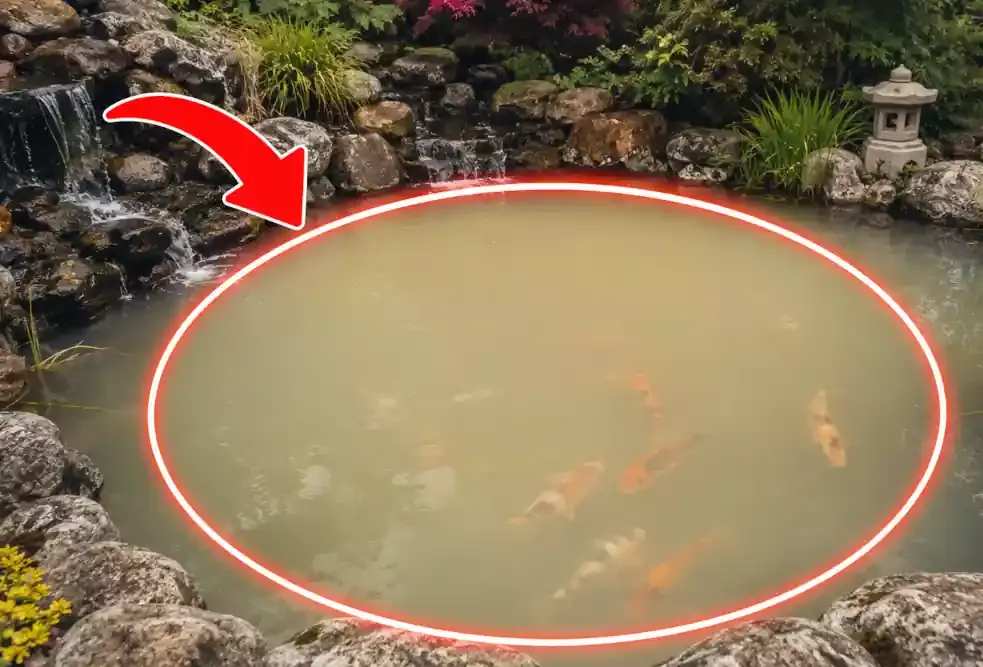
You walked outside expecting to see your koi gliding through sparkling water. Instead, your pond looks like someone poured in a gallon of milk, blended up a bag of leaves, or replaced the water with pea soup.
Even worse, your koi may have vanished beneath the murk.
Cloudy koi pond water can appear suddenly, and it often sends pond owners into panic mode. The good news is that cloudy water is usually fixable. The bad news is that dumping in random chemicals, draining the pond, or aggressively cleaning the filter can make the problem much worse.
Appearance provides clues, but white, green, brown, and gray water can have overlapping causes. Check fish, oxygen support, equipment, and reliable water tests before choosing a correction. If fish have serious breathing trouble or lose balance, seek prompt help alongside those checks.
Before you reach for a bottle of pond treatment, take a breath. Your pond is not necessarily ruined, and your koi have not packed their tiny underwater suitcases.
Let’s figure out why your koi pond is cloudy and how to clear it safely.
First: What Color Is the Cloudy Water?
Examine a sample and recent history to gather clues. Color alone cannot diagnose the cause or establish safety; the fish and test results take priority.
- White or milky water: Often caused by a bacterial bloom, a newly established pond, or disrupted biological filtration.
- Green water: Usually caused by free-floating algae.
- Brown or tea-colored water: Often caused by leaves, tannins, soil runoff, or decaying organic material.
- Gray or dirty-looking water: Usually suspended debris, fish waste, sediment, or inadequate mechanical filtration.
- Cloudy water after rain: May be caused by runoff, disturbed sediment, changing pH, or organic debris washing into the pond.
- Cloudy water after a water change: inspect refill method, source-water disinfectants and chemistry, disturbed sediment, and test results; do not infer a cause from timing alone.
The color gives you a starting point, but you should not diagnose a pond based on appearance alone.
Test the Water Before You Try to Fix It
Cloudy water is not always dangerous. Crystal-clear water is not always safe.
A pond can look beautiful while containing toxic ammonia or nitrite. Another pond can look temporarily cloudy while maintaining perfectly safe water parameters.
Before adding treatments, test the following:
- Ammonia
- Nitrite
- Nitrate
- pH
- KH, or carbonate hardness
- Chlorine or chloramine if you recently added tap water
Ammonia and nitrite should normally be below the detection limit of suitable tests in an established system. A detectable result needs investigation in context, including temperature, pH, recent inputs, and test compatibility. Protect the koi before working on cosmetic clarity.
Do not keep feeding heavily while ammonia or nitrite is elevated. Food entering the fish eventually becomes waste entering the water.
1. Your Pond Is Experiencing a Bacterial Bloom
If the pond water looks white, hazy, or milky, you may be seeing a bacterial bloom.
This frequently happens in new ponds, recently cleaned ponds, or ponds where the filter has been disturbed. Large numbers of bacteria multiply in the water as they feed on available organic material.
It can look alarming, but it does not always mean the pond is contaminated or diseased.
Common triggers include:
- Starting a new koi pond
- Adding several fish at once
- Overfeeding
- Cleaning biological filter media too aggressively
- Using chlorinated water on filter media
- Turning the filtration system off for an extended period
- A sudden increase in organic waste
How to fix it
Test ammonia and nitrite first. Reduce feeding if either is present. Keep the filter running continuously and make sure the pond has strong aeration.
A suspected microbial bloom needs oxygen and chemistry monitoring while the underlying load and system operation are reviewed. It may improve as conditions recover, but appearance does not prove safety. Avoid routine full draining or filter sterilization as a clarity fix.
Patience is difficult when your pond resembles watered-down milk, but sometimes the best treatment is stability.
2. Your Biological Filter Is Not Fully Established
A koi pond is not just a container of water. It is a living ecosystem supported by bacteria.
Beneficial bacteria convert toxic ammonia into nitrite and then convert nitrite into less harmful nitrate. These bacteria colonize filter media, pond surfaces, rocks, plumbing, and other wet areas.
In a new pond, this bacterial community has not yet fully developed. The result can be cloudy water, unstable water quality, and fluctuating ammonia or nitrite.
This is often called new pond syndrome.
Signs of an immature biological filter
- The pond was recently built or restarted
- Fish were recently added
- Ammonia or nitrite is detectable
- The water changes between clear and cloudy
- The filter was recently replaced or deep-cleaned
How to fix it
Maintain appropriate filtration and oxygen support, reduce new loading as needed, and monitor ammonia and nitrite. Delay additional fish until capacity is demonstrated again. For an unstocked new system, use a controlled fishless protocol rather than using fish to test its limits.
A bacterial starter, where appropriate, cannot certify capacity or substitute for oxygen, suitable flow and chemistry, and repeated load-based tests. Investigate why the existing system is not processing the load before relying on a bottle.
3. Your Mechanical Filter Cannot Keep Up
Biological filtration processes dissolved waste. Mechanical filtration physically removes solids such as:
- Fish waste
- Uneaten food
- Algae fragments
- Leaves
- Mud
- Plant debris
- Fine suspended particles
If these particles remain in circulation, the pond may look gray, dirty, or generally murky.
This is especially common when a pond has a powerful pump but inadequate mechanical filtration. The pump keeps grinding and circulating debris, while the filter fails to capture it.
How to fix it
Inspect and clean the mechanical filtration stages according to the manufacturer’s instructions. Check filter pads, screens, settlement chambers, sieves, drums, or other solids-removal components.
Do not confuse mechanical filter cleaning with biological filter sterilization. Mechanical filter components may need frequent cleaning, while biological media should normally be handled much more gently.
If the filter becomes dirty again almost immediately, it may be undersized for the pond, fish load, or feeding rate.
4. You May Be Overfeeding the Koi
Koi are masters of emotional manipulation.
They rush to the surface, open their mouths, and behave as though they have not eaten since the previous century. Five minutes after a meal, they may return and insist that starvation is imminent.
Do not believe them.
Excess food breaks down in the pond and increases the load on both mechanical and biological filtration. Even food that is eaten contributes to waste production.
Signs you may be overfeeding
- Food remains after several minutes
- The filter clogs unusually quickly
- Ammonia begins to rise
- The pond develops foam or an oily surface
- Water clarity worsens after feeding
- Waste accumulates on the pond bottom
How to fix it
Reduce the portion size and observe how quickly the koi consume the food. Remove uneaten pellets when practical.
During a water-quality problem, temporarily reducing or stopping feeding can give the filtration system time to catch up. Healthy adult koi can generally tolerate a short feeding pause far better than they can tolerate toxic water.
5. There Are Too Many Koi in the Pond
Small koi have an inconvenient habit of becoming large koi.
A pond that seemed spacious when the fish were six inches long can become crowded once those same koi grow into thick, powerful adults.
More koi means:
- More waste
- More oxygen demand
- More food
- More pressure on the filter
- Less room for error
If cloudy water repeatedly returns even after cleaning the mechanical filter, reducing feeding, and performing proper maintenance, the pond may simply contain more fish than the system can support.
How to fix it
You may need to upgrade the filtration system, increase aeration, reduce the number of fish, reduce feeding, or enlarge the pond.
There is no universal stocking rule that works for every koi pond. Pond volume, fish size, filter design, flow rate, oxygenation, climate, and maintenance habits all matter.
6. Decaying Leaves and Organic Debris Are Polluting the Water
Leaves, dead plants, algae, uneaten food, and fish waste eventually begin to decompose.
As this material breaks down, it can discolor the water, consume oxygen, produce unpleasant odors, and add nutrients that encourage algae and bacterial growth.
A pond bottom covered in decaying muck is not just unattractive. It becomes a slow-release pollution system.
How to fix it
Remove leaves and large debris with a net. Clean skimmer baskets and empty settlement areas. Use a pond vacuum when appropriate, but avoid stirring the entire pond bottom into a giant cloud.
Trim dead plant growth and prevent lawn clippings, mulch, soil, and fertilizer from entering the pond.
During autumn, a pond net can prevent an impressive amount of future misery.
7. Sediment Has Been Disturbed
Sometimes the pond is cloudy because something stirred up the bottom.
Possible culprits include:
- Koi digging through gravel
- Heavy rain
- A recently repositioned pump
- Pond cleaning
- Water being added too forcefully
- Animals entering the pond
- A bottom drain or return jet moving loose debris
Koi naturally investigate the bottom with their mouths. If the pond contains loose soil, fine gravel, or accumulated sludge, the fish may keep the material suspended.
How to fix it
Improve solids removal and eliminate areas where debris collects. Redirect returns if they are blasting directly into sediment. Use fine mechanical filtration temporarily to capture suspended particles.
If substantial foul sludge has accumulated, do not aggressively stir it into occupied water. Plan controlled removal and appropriate fish protection with experienced help where needed. A routine vacuum session is not automatically suitable for a neglected pond.
8. Green Water Algae Have Taken Over
If you cannot see your koi because the pond looks like green soup, the culprit is usually free-floating algae.
Green water algae thrive when they have abundant sunlight and nutrients.
Common contributing factors include:
- High nutrient levels
- Excessive feeding
- Insufficient filtration
- Heavy sunlight exposure
- An undersized ultraviolet clarifier
- A fouled sleeve or lamp beyond its specified useful service life
- Water moving too quickly through the UV unit
How to fix it
Check the pond’s nutrient load and filtration before blaming sunlight alone. A properly sized and functioning ultraviolet clarifier can be extremely effective against free-floating algae.
Follow the manual for lamp service, sleeve inspection, and permitted flow. Visible glow alone cannot establish effective UV output. Isolate equipment as instructed and never look at an exposed energized UVC lamp or bypass its safety interlock.
Remember that a UV clarifier kills or clumps suspended algae, but the filtration system must still remove the dead material.
Do not confuse green water algae with string algae attached to rocks, waterfalls, or pond walls. A UV clarifier helps control algae floating through the unit, not algae firmly attached to surfaces.
9. A Water Change Accident Disrupted the Pond
Cloudiness sometimes appears shortly after a water change.
Possible causes include:
- Chlorine or chloramine damaging beneficial bacteria
- Sediment being stirred up
- A sudden temperature change
- A sudden pH or KH change
- Debris being flushed from plumbing
- Filter media being washed with untreated tap water
Municipal tap water is commonly treated to make it safe for people, but those disinfectants can injure fish and filter bacteria.
How to fix it
Use a suitable conditioner when adding disinfectant-treated water. Follow that product's dose basis, contact time, chloramine guidance, and direct-refill instructions; some directions depend on the way water is added. Do not assume every product uses only the new-water volume or removes every possible contaminant.
Add water gradually when possible, especially when the source water differs significantly in temperature or chemistry.
Never walk away from a filling pond unless you are eager to discover how long your garden hose takes to create a neighborhood wetland.
Cloudy Koi Pond Troubleshooting Chart
AppearancePossible causesWhat to checkFirst investigationWhite or milkyMicrobial growth, fine particles, recent disruptionAmmonia, nitrite, oxygen, load and service historyConfirm support and investigate capacity and inputsGreenSuspended algaeOxygen trend, nutrients, UV operationCheck load and UV performance without assuming harmlessnessBrownTannins, sediment, organics, runoffSettled sample, source water, bottom and drainageIdentify and stop the input before treatmentGray or dirtySuspended waste or sedimentCollection and mechanical filtrationInspect capture, discharge, and disturbanceAfter rainRunoff, sediment, chemistry changeDrainage, source exposure, pH and alkalinityProtect fish, test, and stop runoffAfter refillDisinfectant or chemistry exposure, disturbed materialConditioning method, source water, testsCheck compatibility and correct the identified problemWhat Not to Do When Your Pond Turns Cloudy
Pond owners often make their biggest mistakes during the first hour of panic.
Do not drain the entire pond
Do not fully drain as a routine clarity fix. A major drain may be necessary for a defined contamination or repair problem, but needs a suitable fish-holding and recovery plan. Unplanned draining can create unsafe conditions and disrupt the system.
Do not add several treatments at once
If you pour in algae treatment, bacteria, clarifier, salt, medication, and something recommended by a stranger in a parking lot, you may never know what helped—or what caused the next problem.
Do not completely sterilize the filter
Your biological filter depends on living bacteria. Cleaning every surface until it is spotless can remove the organisms keeping the pond safe.
Do not keep feeding normally when ammonia is present
More food creates more waste. Temporarily reducing food can help the system recover.
Do not assume clear water equals healthy water
Always trust a reliable test kit more than your eyes.
How Long Does It Take for Cloudy Pond Water to Clear?
The answer depends on the cause.
- Suspended debris: improvement depends on particle size, collection, and functioning mechanical removal. Monitor the result rather than assuming a fixed clearing time.
- Suspected microbial bloom: review the load, oxygen, and biological operation. Persistent cloudiness or changed tests needs investigation rather than a promised recovery deadline.
- Green water algae: response depends on correct UV sizing, permitted flow, lamp and sleeve condition, nutrient load, and downstream waste removal.
- Brown water: distinguish dissolved staining from suspended soil or contamination before selecting debris removal, controlled water replacement, or a suitable adsorbent.
- Overstocking or undersized filtration: The cloudiness may continue returning until the underlying system problem is corrected.
Clearing the water without correcting the cause is like silencing a smoke alarm without looking for smoke.
When Cloudy Water Is an Emergency
Cloudiness becomes urgent when it appears alongside signs of fish distress.
Watch for:
- Koi gasping at the surface
- Fish gathering near a waterfall or air diffuser
- Clamped fins
- Lethargy
- Flashing or rubbing against objects
- Red streaks or visible irritation
- Sudden refusal to eat
- Ammonia or nitrite above zero
- A major or sudden pH change
For gasping or serious breathing trouble, confirm and support aeration and flow safely, test water promptly, and seek fish-health help at the same time. Oxygen problems, ammonia, nitrite, disinfectants, and gill disease can overlap. Do not postpone assistance until every home test is completed.
Focus on keeping the koi alive before trying to make the pond beautiful.
How to Keep the Pond Clear Long-Term
Clear water is not created by one miracle product. It is usually the result of several boring things working correctly every day.
- Use properly sized mechanical and biological filtration.
- Run the filtration system continuously.
- Provide strong aeration.
- Test water regularly.
- Feed appropriate portions.
- Remove leaves and debris before they decompose.
- Clean mechanical filters before they become clogged.
- Protect the pond from soil, fertilizer, and lawn runoff.
- Avoid adding too many koi.
- Use dechlorinator during water changes.
- Inspect UV clarifiers and replace bulbs as needed.
The goal is not to force the pond into looking clean for a weekend. The goal is to create a stable system that stays healthy throughout the season.
Cloudy koi pond water is not a diagnosis. It is a symptom.
White water may point to bacteria. Green water usually points to algae. Brown water often points to leaves, tannins, or runoff. Gray water commonly indicates suspended waste or sediment.
Start by testing the water. Then inspect the filtration system, feeding habits, fish load, debris levels, and recent changes to the pond.
Most importantly, resist the urge to attack the pond with every chemical on the shelf.
Your koi do not need a frantic owner with a measuring cup and six open bottles. They need stable water, adequate oxygen, dependable filtration, and a little patience.
Once you identify what the water is trying to tell you, the mysterious cloud usually becomes a manageable—and preventable—problem.
Have you ever walked outside and found your koi pond cloudy overnight? Share this guide with another pond owner before they drain the entire pond and accidentally make the problem worse.
Choose the Next Detailed Guide
Use water testing, UV troubleshooting, safe water changes, filter matching, and maintenance for the identified problem. The multi-symptom first-check guide provides a short comparison; distress response covers urgent signs. Record the correction and recheck rather than relying on appearance alone.