A pond does not need a referee to signal trouble. Fish behavior, test readings and equipment flow provide warning signs. Use these twelve red flags to decide what to check promptly, rather than to diagnose a disease from one symptom.
Breathing distress, loss of balance or rapid deterioration needs immediate attention. Increase aeration safely, pause feeding and seek qualified fish-health help while checking the habitat.
Red Flag #1: Koi Gasping at the Surface
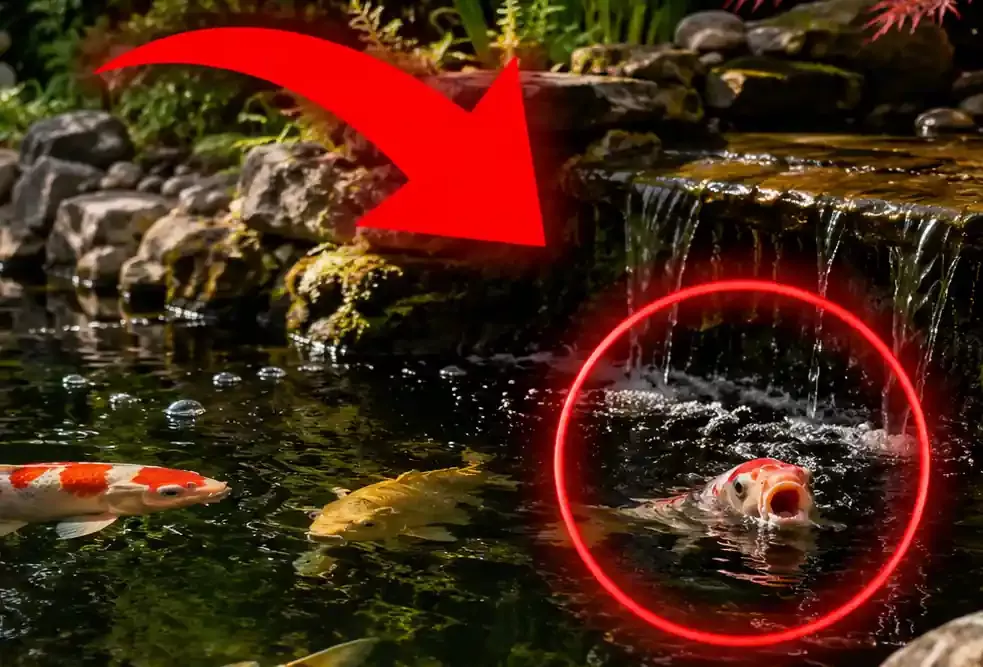
If your koi are hanging at the surface with their mouths opening and closing like they are trying to gossip with the patio furniture, do not ignore it.
Surface gasping is one of the biggest koi pond red flags.
It often means the fish are struggling to get enough oxygen. This can happen during hot weather, after an algae bloom dies off, when the pond is overstocked, when pumps or aeration fail, or when water quality problems interfere with breathing.
Koi may also crowd around waterfalls, air stones, fountains, or filter returns because those areas usually have more oxygen.
That is not cute.
That is your pond’s version of every player on the field sprinting toward the only working oxygen mask.
What to do immediately:
- Turn on extra aeration.
- Make sure the waterfall and pump are running strongly.
- Check for clogged skimmers, baskets, or filters.
- Stop feeding temporarily.
- Test ammonia, nitrite, pH, KH, and temperature.
If any koi is repeatedly gasping or struggling to breathe, respond promptly. Improve aeration safely and check actual flow and water conditions while arranging help; do not wait for the whole group to be affected.
Red Flag #2: Flashing or Rubbing
Flashing is when koi suddenly dart, twist, or rub against the pond bottom, liner, rocks, or walls. It often looks like the fish is trying to scratch an itch it cannot reach.
Occasional rubbing may happen, but repeated flashing is a red flag.
Possible causes include:
- Parasites
- Ammonia irritation
- Nitrite problems
- pH swings
- Chemical irritation
- Poor water quality
In soccer terms, flashing is not a casual foul. It is a warning that something is irritating the fish.
The mistake many pond owners make is immediately assuming parasites and dumping treatment into the pond. Parasites are possible, but water quality should be checked first. Treating fish in bad water is like giving a player new cleats while the field is on fire.
What to do immediately:
- Test ammonia and nitrite.
- Check pH and KH for stability.
- Look for other symptoms like clamped fins, redness, or lethargy.
- Inspect recent changes: new fish, water change, chemical use, filter cleaning, or runoff.
- Consult a koi health expert or vet if parasites are suspected.
Do not panic-treat. Test first. Guessing is how ponds become chemistry experiments with fish in them.
Red Flag #3: Clamped Fins
Healthy koi usually swim with fins open and relaxed. When a koi clamps its fins tight to the body, it often means the fish is stressed, irritated, or unwell.
Clamped fins are like a player walking around holding their ribs after a collision. Maybe it is minor. Maybe it is not. But it deserves attention.
Common causes include:
- Poor water quality
- Parasites
- Temperature stress
- Low oxygen
- Recent transport or handling
- Sudden pH changes
- Bacterial issues
The problem with clamped fins is that they are easy to dismiss. A pond owner might think, “That fish is just being weird today.”
Maybe.
But koi do not usually wake up and decide to look miserable for dramatic effect. Although, to be fair, they do beg for food like professional actors.
What to do immediately:
- Watch whether one fish or several fish are affected.
- Test water quality.
- Check temperature and aeration.
- Look for flashing, redness, sores, gasping, or isolation.
- Reduce feeding until you know what is happening.
The number of affected fish is useful information, not a diagnosis. A water problem can affect one fish first; disease or another shared exposure can affect several. Check the habitat in either case.
Red Flag #4: Ammonia Above Zero
If koi ponds had actual referees, ammonia would get a straight red card every time.
Ammonia is produced by fish waste, uneaten food, decaying plants, sludge, and organic material breaking down in the pond. In a healthy, mature pond, beneficial bacteria convert ammonia into nitrite and then nitrate as part of the nitrogen cycle.
But when the biofilter is immature, overloaded, damaged, or oxygen-starved, ammonia can rise.
That is bad news.
Ammonia can irritate gills, damage fish, reduce health, and create serious pond emergencies. It is especially dangerous at higher pH and warmer temperatures.
Translation: ammonia is not “a little pond issue.” Ammonia is the villain wearing a trench coat and sneaking into your filter system.
Common causes of ammonia spikes:
- Overfeeding
- Too many fish
- New pond syndrome
- Dead fish or decaying organic matter
- Filter failure
- Over-cleaned biological media
- Power outages
- Sudden algae die-off
What to do immediately:
- Stop feeding.
- Add aeration.
- Check the filter and pump flow.
- Remove debris and uneaten food.
- Do a partial water change with dechlorinated water if needed.
- Use a conditioner only when appropriate for the problem and according to its label; understand how it affects your ammonia test and continue investigating waste processing
- Keep testing until ammonia returns to zero.
For more help with water testing, see: Koi Pond Water Quality Guide
Red Flag #5: Nitrite Above Zero
Nitrite is the sneaky sequel to ammonia.
In the nitrogen cycle, bacteria convert ammonia into nitrite, and then another group of bacteria converts nitrite into nitrate. In a stable pond, nitrite should not build up. If it does, something is wrong with the biological filtration or the pond is going through a cycle imbalance.
Nitrite is dangerous because it can interfere with the fish’s ability to transport oxygen in the blood. That means fish can act like they are suffocating even when the water seems to have oxygen.
Yes, pond chemistry can be that rude.
Signs that may appear with nitrite trouble:
- Gasping
- Lethargy
- Fish hanging near moving water
- Clamped fins
- Breathing distress requiring assessment; do not handle a fish to inspect gills without appropriate experience
- Sudden weakness after an ammonia spike
What to do immediately:
- Stop feeding.
- Increase aeration.
- Confirm the reading with a reliable test kit.
- Check ammonia too.
- Perform partial water changes with dechlorinated water if needed.
- Support the biofilter and avoid over-cleaning biological media.
Aim for no detectable ammonia or nitrite with a suitable test. Interpret total ammonia alongside temperature and pH; check units, expiry and possible treatment interference before treating an apparent number as the whole explanation.
Red Flag #6: The Pump, Waterfall, or Filter Slows Down
Your pond’s pump and filter are not decorative accessories. They are life support.
When the waterfall slows to a sad trickle, the skimmer barely pulls, or the filter flow drops, your pond is waving a giant red flag.
Reduced flow can mean:
- Clogged skimmer basket
- Clogged pump intake
- Dirty filter pads
- Blocked plumbing
- Failing pump
- Low water level
- Air lock
- Excess algae or debris
Less flow means less filtration, less oxygen exchange, and less waste movement. The pond may look calm, but calm is not always good. A koi pond should not behave like a forgotten birdbath.
What to do immediately:
- Check the skimmer basket.
- Isolate power as the equipment instructions require before inspecting an intake or handling a pump
- Clean mechanical filtration.
- Check the water level.
- Verify the pump is running normally.
- Look for blocked plumbing or collapsed hoses.
For filtration basics, see: Koi Pond Filtration Guide
Red Flag #7: Sudden Cloudy Water
Cloudy water is the pond equivalent of a suspicious VAR review: something happened, and now everyone needs to pay attention.
Cloudy water can be caused by:
- Bacterial blooms
- Suspended debris
- Overfeeding
- New pond cycling
- Spawning activity
- Filter problems
- Runoff after rain
- Dead algae
Not all cloudy water is an emergency, but sudden changes deserve investigation.
The key question is: did the fish behavior change too?
If the water is cloudy but the fish are active, eating, and water tests are good, you may have a filtration or suspended-particle issue. If the water is cloudy and fish are gasping, clamping fins, flashing, or refusing food, treat it seriously.
What to do immediately:
- Test ammonia, nitrite, pH, and KH.
- Check filter flow.
- Clean mechanical filtration.
- Stop or reduce feeding.
- Add aeration.
- Check for runoff or decaying debris.
Do not just dump in a clarifier and walk away. Clear water is not the same as safe water.
Red Flag #8: Foam That Does Not Go Away
A little foam near a waterfall can be normal. Moving water creates bubbles. That is not automatically a crisis.
Persistent foam can reflect organic buildup, but detergent or other contamination is another possibility. Check recent cleaning, runoff and exposure before choosing a response; foam alone does not identify the substance.
That can come from:
- Overfeeding
- Fish waste
- Spawning
- Decaying plant matter
- Dirty filters
- Protein buildup
- Poor water changes
If the pond looks like someone added bubble bath, investigate.
Koi ponds are many things. A foam party should not be one of them.
What to do immediately:
- Check water parameters.
- Clean mechanical filters.
- Remove debris and excess organics.
- Reduce feeding.
- Consider a partial water change with dechlorinated water.
- Increase aeration and circulation.
Red Flag #9: Foul Smell
A healthy koi pond should smell earthy, fresh, or mildly pond-like. It should not smell like rotten eggs, sewage, swamp gas, or a haunted compost pile.
Bad smells can point to decaying organic matter, anaerobic muck, dead animals, clogged filters, stagnant areas, or poor circulation.
Basically, if your pond smells like it belongs in a crime documentary, do not ignore it.
What to do immediately:
- Look for dead fish, frogs, rodents, or other animals.
- Remove reachable waste gently; do not churn deep foul deposits into the occupied pond
- Check filter pads and settlement areas.
- Improve circulation.
- Add aeration.
- Test water quality.
Smell is not a precise diagnostic tool, but it is a very good attention-getter.
Red Flag #10: One Fish Isolating From the Group
Koi are social. They usually move together, feed together, and patrol the pond like a slow-motion neighborhood watch committee.
So when one koi starts hanging alone, sitting at the bottom, hiding constantly, or avoiding the group, pay attention.
Isolation can indicate:
- Illness
- Parasites
- Injury
- Stress
- Bullying or spawning exhaustion
- Water quality sensitivity
One isolated koi does not always mean the whole pond is crashing. But it does mean that fish needs observation.
Do not wait until the koi is floating sideways before deciding it was “acting a little off.”
What to do immediately:
- Watch the fish closely.
- Check for sores, redness, raised scales, fin damage, or odd swimming.
- Test the water.
- Look at the rest of the pond population.
- Prepare a quarantine tank if the fish worsens or needs treatment.
For more fish-health help, see: Koi Health Guide
Red Flag #11: Sudden Algae Die-Off
Algae can be annoying, but dead algae can be dangerous.
When a large algae bloom dies quickly, all that organic material begins decomposing. That process can consume oxygen and stress the pond, especially in warm weather or heavily stocked systems.
This is why aggressive algae treatments can backfire if the pond is not aerated properly.
It is like removing the opposing team from the field by dropping them all in your filter at once. Technically, the algae is gone. Practically, you may have created a whole new problem.
What to do immediately:
- Add strong aeration before and after algae treatment.
- Remove dead algae when possible.
- Clean mechanical filters.
- Monitor ammonia and nitrite.
- Avoid killing too much algae at once.
Algae control should be a plan, not a revenge mission.
Red Flag #12: Koi Suddenly Stop Eating
Koi usually treat food like it is the most important event in world history.
So if they suddenly stop eating, something may be wrong.
Possible causes include:
- Cold water
- Hot water stress
- Low oxygen
- Poor water quality
- Parasites or illness
- Recent predator scare
- Recent handling or transport
- Spawning stress
One skipped meal may not matter. But a sudden group refusal should get your attention.
If koi ignore food, do not keep throwing more in “just to see.” That uneaten food becomes waste, and waste becomes water quality trouble.
What to do immediately:
- Remove uneaten food.
- Test water quality.
- Check water temperature.
- Observe fish behavior.
- Reduce feeding until they act normal again.
The Ultimate Koi Pond Red Flag Rule
Here is the easiest way to think about koi pond warning signs:
If several fish act weird at the same time, test the water immediately.
One fish behaving differently can have an individual health problem or be the first fish affected by a shared condition.
Several affected fish make a common exposure important to investigate. Water problems and infectious disease are both possibilities; test and observe rather than relying on the group size alone.
That environment is the water.
Koi live in it. Breathe through it. Eat in it. Sleep in it. Swim in it. Their entire world is your pond water.
If the water goes bad, the fish cannot walk off the field and complain to the referee.
They only have behavior.
That behavior is your warning system.
What Not to Do When You See Red Flags
When pond owners see trouble, they often want to do something immediately. That instinct is good. The problem is when “something” becomes “anything.”
Avoid these panic moves:
- Do not dump in multiple treatments at once.
- Do not medicate without checking water quality.
- Do not overfeed sick or stressed fish.
- Do not shut off pumps or waterfalls.
- Do not deep-clean the entire biofilter at once.
- Do not add untreated tap water.
- Do not ignore ammonia or nitrite.
- Do not assume clear water means safe water.
A koi pond is not a magic potion. You cannot fix it by pouring in every bottle from the garage shelf and hoping the pond gods are impressed.
Build a Pond That Survives the Red Cards
The best koi keepers are not the ones who never have problems. They are the ones who notice problems early and respond intelligently.
To reduce red-flag emergencies:
- Test water regularly.
- Aim for no detectable ammonia or nitrite; investigate positive readings promptly.
- Maintain strong aeration.
- Use properly sized filtration.
- Clean mechanical filters before they clog.
- Protect biological filter media.
- Avoid overfeeding.
- Avoid overcrowding.
- Quarantine new fish.
- Watch koi behavior every day.
The best time to catch a pond problem is when it is still small, boring, and easy to fix.
By the time fish are gasping, the water smells terrible, and the waterfall has turned into a weak little dribble, the match has already gotten ugly.
Final Thought: Your Koi Are the Referee
Warning signs matter because acting early can keep a small problem from escalating.
In soccer, a red card can shift the match, change the strategy, anger the fans, and dominate headlines.
In a koi pond, a red flag can be even more important.
Gasping is a red flag.
Flashing is a red flag.
Clamped fins are a red flag.
Ammonia is a red flag.
Nitrite is a red flag.
A dead pump is a red flag.
A fish isolating itself is a red flag.
Ignore enough of them, and your pond can go from peaceful backyard paradise to emergency situation fast.
Keep the sporting analogy in the headline’s spirit, but let actual pond evidence guide the response.
Your job is simpler: watch your fish, test your water, keep the equipment running, and never ignore the signs your koi are giving you.
Because koi do not fake injuries for the referee.
When they show you something is wrong, believe them.
Quick Koi Pond Red Flag Checklist
- Koi gasping at the surface
- Fish crowding near waterfalls or air stones
- Repeated flashing or rubbing
- Clamped fins
- Bottom-sitting or lethargy
- One fish isolating from the group
- Sudden refusal to eat
- Ammonia above zero
- Nitrite above zero
- Cloudy water or persistent foam
- Foul smell
- Slow pump, weak waterfall, or clogged filter
- Sudden algae die-off
- Unusual redness, sores, or fin damage
Notice changes early, write down observations and test readings, and respond to breathing distress immediately. A list of red flags is a starting point for investigation, not a prescription for medication.
For a structured investigation, see UF/IFAS fish-health problem solving and our koi health guide.