Much of a koi pond’s important work is too small to see. Microorganisms on biological filter media and other surfaces help process fish waste. Think of them as a quiet maintenance crew: a useful analogy, not a literal communication network.
The biology depends on oxygen, water chemistry, suitable surfaces and the load arriving from the fish. A clear pond can still have an underperforming biofilter.
Your Koi Pond Is Not Just Water With Fish In It
Many beginners look at a koi pond and see three things:
- Water
- Fish
- Maybe a waterfall that makes them feel emotionally superior to neighbors with regular lawns
But a healthy koi pond is much more than that.
It is a living ecosystem.
Fish release ammonia, organic material breaks down, and microorganisms process waste. Biological filters provide managed surfaces with flowing water and oxygen. Plants can take up nutrients, while mechanical filtration collects solids for removal. These processes interact; they are not an underground fungal messaging system.
It is basically a tiny aquatic city, except the residents are bacteria and the rent is paid in fish poop.
That may not sound glamorous, but it is the foundation of koi keeping.
A pond can have crystal-clear water, beautiful fish, expensive equipment, and perfect landscaping — but if the invisible biological network fails, the whole system can crash.
The Invisible Network That Keeps Koi Alive
The most important hidden workers in a koi pond are beneficial bacteria.
These bacteria colonize wet surfaces throughout the pond, especially areas with oxygen-rich water flow. The filter media is their favorite luxury apartment complex because it provides lots of surface area and constant access to water carrying fish waste.
You will find beneficial bacteria on:
- Biological filter media
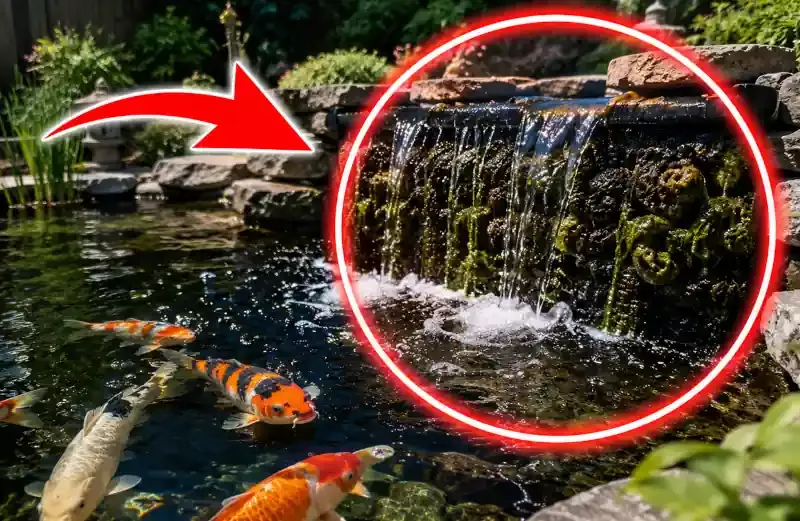
- Waterfall rocks
- Pond liner
- Plant baskets
- Gravel and rock surfaces
- Pipes and plumbing
- Skimmer walls
- Stream beds
- Any wet surface with oxygen and water movement
Routine operation depends on living microorganisms, rather than sterilizing every wet surface. Targeted disinfection may still be needed under a defined disease-control or quarantine protocol. That is a different task from normal pond cleaning.
A healthy pond is alive.
The trick is keeping the right kind of life in balance.
The Nitrogen Cycle: The Gross Miracle Happening in Your Pond
Let’s talk about the glamorous world of fish waste.
Koi eat food. Koi produce waste. Uneaten food breaks down. Organic debris rots. All of that can produce ammonia, which is dangerous to fish.
That sounds bad, because it is.
In a functioning biofilter, nitrifying microorganisms convert ammonia to nitrite and then nitrate. Nitrate still needs management through suitable water changes or other deliberate nutrient export. Ordinary nitrification is conversion, not complete waste removal.
This process is called nitrification, and it is a major part of the pond nitrogen cycle.
Or, to put it less scientifically:
Your koi make waste, and an invisible bacterial cleanup crew prevents the pond from turning into a toxic fish toilet.
That is the hidden miracle.
It happens every day in a healthy pond.
No applause. No parade. No one writes a thank-you card to the bacteria. But without them, koi keeping becomes a nightmare very quickly.
Why Clear Water Can Lie to Your Face
Here is one of the most dangerous myths in koi keeping:
“The water looks clear, so it must be healthy.”
Nope.
Clear water is nice. Clear water is pretty. Clear water looks great in photos. Clear water makes visitors say, “Wow, your pond is so clean,” while you pretend you are not secretly proud.
But clear water does not automatically mean safe water.
Ammonia can be invisible. Nitrite can be invisible. A weak biofilter can be invisible. Low alkalinity can be invisible. A coming pH crash can be invisible. A pond can look like a luxury resort and still be chemically plotting against your koi.
This is why water testing matters.
You cannot eyeball the nitrogen cycle.
You cannot look at a koi and say, “Yes, the ammonia level is probably zero because Gerald is swimming with confidence.”
Gerald may be brave. Gerald may be handsome. Gerald is not a test kit.
If you want to know what is happening in the invisible network, test the water.
Your Filter Is Not Just a Filter — It Is a Bacteria Hotel
Many pond owners think the filter’s main job is to catch dirt.
That is only partly true.
Mechanical filtration catches visible debris like leaves, fish waste, algae clumps, and uneaten food. That part matters. But biological filtration is where the real magic happens.
Your biological filter is basically a high-density housing development for beneficial bacteria.
Biological media provides colonization surfaces, but a surface-area claim alone does not establish capacity. Actual performance depends on water flow, oxygen, chemistry, temperature and feed load. Verify that performance with water tests.
This is why filter design matters.
A biological filter is a managed part of the waste-processing system. Calling it a network is a metaphor; it is not a nervous system.
For more filtration information, see: Koi Pond Filtration Guide
The Biggest Way Pond Owners Accidentally Destroy the Hidden Network
Here is where things get painful.
A lot of koi pond disasters happen because the owner tries to “clean” the pond too aggressively.
They see some algae, biofilm, filter gunk, or brownish pond life and think:
“This looks dirty. I should scrub everything until it looks brand new.”
That sounds responsible.
It can also be a biological crime scene.
Remember, the beneficial bacteria live on surfaces. They live in the filter. They live in biofilm. They live where water and oxygen flow. If you blast everything with chlorinated tap water, deep-clean every surface, sterilize the filter, and remove all the living film at once, you may wipe out a huge part of the pond’s life-support system.
Your pond may look cleaner for a moment.
Your bacteria may be dead.
Your koi may be about to have a very bad week.
Biofilm: The Slime You Should Not Automatically Hate
Biofilm has a public relations problem.
It looks like slime. It feels like slime. Nobody wants to invite friends over and say, “Please admire the thriving slime layer on my waterfall rocks.”
But biofilm is not automatically bad.
Biofilms contain communities of microorganisms and can participate in nutrient processing. They can also harbor unwanted organisms; appearance alone does not identify a film as beneficial or prove that water is safe.
Now, there is a difference between healthy biofilm and disgusting sludge.
A surface film is not automatically a reason to scrub the entire pond. Accumulated leaves, solids and foul sludge still need management. Avoid suddenly stirring deep, oxygen-poor deposits into water occupied by the fish.
The goal is balance.
You want a living pond, not a sterile bathtub and not a swamp monster’s soup bowl.
How to Protect the Invisible Network in Your Koi Pond
If your koi pond has a hidden life-support system, how do you protect it?
By giving beneficial bacteria what they need and avoiding the things that wipe them out.
1. Keep Water Moving
Beneficial bacteria need oxygen-rich water. Stagnant areas can become low-oxygen zones where waste accumulates and the healthy biological process slows down.
Run your pumps, waterfalls, streams, and circulation system consistently. A koi pond is not meant to sit still like a decorative puddle with expensive fish.
2. Add Plenty of Aeration
Oxygen supports koi and beneficial bacteria. During hot weather, heavy feeding, algae blooms, or filter stress, extra aeration becomes even more important.
Air pumps, diffusers, waterfalls, fountains, and moving water all help support the pond’s invisible workers.
Think of oxygen as coffee for your biofilter. Without it, everything gets sluggish and unpleasant.
3. Do Not Rinse Bio Media With Chlorinated Tap Water
This is one of the classic pond-keeping mistakes.
Biological filter media should not be blasted with untreated chlorinated tap water. Chlorine and chloramine are used to kill microorganisms. Your beneficial bacteria are microorganisms.
See the problem?
If you need to rinse bio media, use pond water whenever possible and avoid over-cleaning. Mechanical filter pads can be cleaned more often, but biological media should be treated like valuable real estate.
4. Do Not Shut Off the Filter for Long Periods
Your biofilter depends on water flow and oxygen. If pumps are shut off too long, bacteria can suffer. Waste processing slows. Water quality can decline.
If you have to shut equipment down for maintenance, keep the downtime as short as practical.
Your waterfall may be decorative to you, but to the pond it is part of the breathing system.
5. Feed Responsibly
Every pellet you toss into the pond becomes part of the biological workload.
If the koi eat it, it becomes waste. If they do not eat it, it becomes rotting food. Either way, the filter has to deal with the result.
Koi begging is not proof they need more food. Koi will beg because koi are adorable con artists in formalwear.
Feed what they can consume quickly, adjust for water temperature, and reduce feeding when water quality is unstable.
6. Avoid Chemical Chaos
Dumping in random treatments can disrupt the pond’s ecosystem. Algae killers, medications, clarifiers, and other products all have specific uses, but they should not be used as panic buttons.
Before adding chemicals, test your water and understand the problem.
The pond shelf full of bottles is not a personality test. You do not get bonus points for using all of them.
7. Do Not Overstock the Pond
More koi means more waste. More waste means more demand on the filter. If the hidden bacterial network cannot keep up, ammonia and nitrite can rise.
A pond can be visually beautiful and biologically overloaded at the same time.
If your koi pond looks like rush hour traffic with fins, your biofilter may be working overtime.
New Pond Syndrome: When the Network Has Not Moved In Yet
One of the most common beginner mistakes is adding koi to a new pond before the biological filter is ready.
A new pond may have clean-looking water, fresh equipment, and a beautiful layout. But the beneficial bacteria population needs time to establish. Until that happens, the pond may not be able to process fish waste effectively.
This is often called new pond syndrome.
The pond looks ready.
The fish are excited.
The owner is excited.
The bacteria are still basically unpacking boxes.
Commission the biological filter before adding fish, using a considered fishless cycling plan and measurements of ammonia and nitrite processing. After commissioning, add stock conservatively and keep testing; elapsed weeks alone do not demonstrate adequate capacity.
For more on the nitrogen cycle, see: Understanding the Nitrogen Cycle
Plants Are Part of the Hidden Network Too
Koi pond plants are not just decoration. They can play a role in nutrient uptake, shade, habitat, and oxygen dynamics.
Plants can take up nutrients, including nitrate, but retained or dying plant material can return some of that load. Managed growth and removal matter. Plants also respire and use oxygen at night; they are not a substitute for reliable aeration.
But plants are not magic.
A few lilies will not fix an overstocked pond with weak filtration and daily buffet-level feeding. Plants are part of the system, not a replacement for proper filtration and water testing.
Use them as allies, not as unpaid pond employees expected to solve every bad decision.
The Hidden Network Can Crash Faster Than You Think
A mature koi pond can be stable for years, then suddenly struggle when something changes.
Common crash triggers include:
- Power outages that stop pumps and aeration
- Over-cleaning the biological filter
- Adding too many fish too quickly
- Heavy overfeeding
- Dead algae after treatment
- Large pH swings
- Low KH/alkalinity
- Chemical contamination
- Medication misuse
- Heat waves and low oxygen
When the invisible network is damaged, the first visible clue may be fish behavior.
Koi may gasp, flash, clamp fins, stop eating, hang near waterfalls, or sit at the bottom. By then, the pond owner is not preventing a problem anymore. They are responding to one.
Signs Your Biofilter May Be Struggling
Watch for these signs that your pond’s hidden network is under stress:
- Ammonia above zero
- Nitrite above zero
- Cloudy water after feeding or cleaning
- Fish gasping near moving water
- Fish flashing or clamping fins
- Sudden foul smell
- Recurring algae blooms
- Water quality swings after filter cleaning
- Fish acting stressed after adding new koi
Investigate detectable ammonia or nitrite promptly, but do not assume every distressed fish proves biofilter failure. Water-source problems, contaminants, gill disease and other causes may produce overlapping signs. Check the full system and seek qualified fish-health help for persistent or severe distress.
For water testing help, see: Koi Pond Water Quality Guide
How to Build a Stronger Hidden Network
A healthy pond ecosystem does not happen by accident. It is built with good habits.
- Use properly sized biological filtration.
- Choose media and a filter design suited to the expected load; verify capacity with actual water results
- Keep strong water circulation.
- Add reliable aeration.
- Stock fish gradually.
- Feed based on water temperature and filter capacity.
- Test water regularly.
- Clean mechanical filters without destroying bio media.
- Keep chlorine and chloramine away from the biofilter.
- Maintain stable KH and pH.
The more stable the pond, the stronger the network becomes.
A good pond keeper is not just keeping fish. They are managing an entire microscopic workforce.
The Shareable Truth: Your Koi Pond Is Alive in Ways You Cannot See
Invisible waste processing is part of why a pond needs more than clear-looking water.
Your koi pond is the same way.
The most important thing in the pond is not always the biggest koi, the clearest water, the prettiest waterfall, or the most expensive pump.
Sometimes the most important thing is the invisible bacteria colony quietly turning poison into something safer while everyone else is admiring the fish.
That is a weirdly beautiful idea.
Your pond is not just a display.
It is a living network.
The fish are the celebrities. The bacteria are the exhausted crew backstage making sure the show does not collapse.
Final Thought: Respect the Stuff You Cannot See
Useful pond biology is best understood through measurements and management, rather than a dramatic analogy to another ecosystem.
For a koi keeper, the practical questions are flow, oxygen, waste load and whether the biological filter is actually keeping up.
Your pond’s health depends on invisible life.
Not just the koi you feed. Not just the plants you trim. Not just the waterfall you photograph. But the bacteria, biofilm, and biological filter working silently every hour of every day.
So the next time you look at your pond, do not just admire the fish.
Admire the network.
Admire the filter quietly doing its job.
Admire the oxygen moving through the water.
Admire the bacteria you will never see but absolutely depend on.
Because your koi pond is not just a backyard decoration.
It is a tiny living universe.
And the secret to keeping koi healthy is learning how to protect the world they live in — especially the parts too small to see.
Quick Checklist: Protect Your Pond’s Hidden Network
- Test ammonia, nitrite, nitrate, pH, KH, and temperature regularly.
- Aim for no detectable ammonia or nitrite; investigate positive readings promptly.
- Run pumps, waterfalls, and aeration consistently.
- Do not rinse biological media with chlorinated tap water.
- Clean mechanical filters without nuking the biofilter.
- Stock koi slowly and avoid overcrowding.
- Feed only what your fish and filter can handle.
- Maintain stable oxygen, pH, and alkalinity.
- Avoid unnecessary chemical treatments.
- Remember that clear water is not a substitute for testing.
Protect biological filtration through suitable conditions and measured performance. Remove captured waste and maintain the whole habitat rather than treating every patch of biofilm as proof of a healthy pond.
Learn more from UF/IFAS ammonia guidance, fishless cycling and biological filtration.