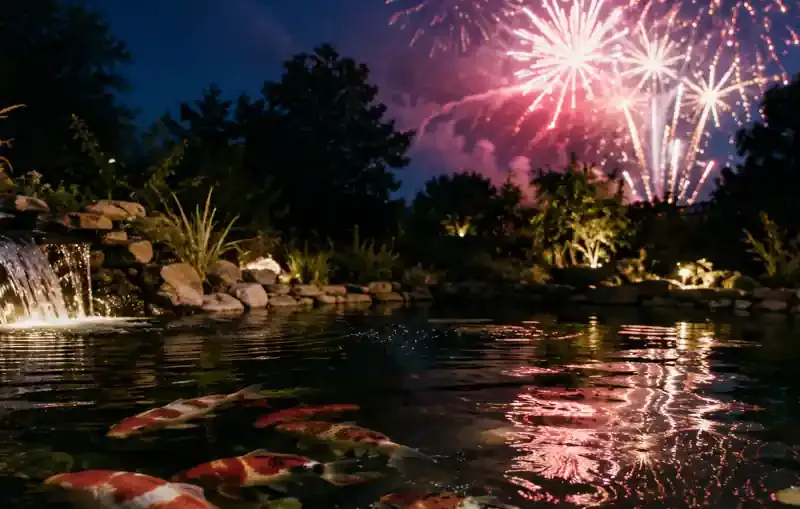
Fireworks nights bring guests, pets, noise, light and possible debris near a backyard pond. Plan the gathering so the koi’s water, equipment and space remain protected. Keep fireworks well away from the pond and observe the fish without crowding or chasing them.
The precautions below draw on general fish-sensory and stress information. They do not establish a koi-specific safe distance, sound threshold or guaranteed reaction to fireworks.
Can Fish Detect Sound and Vibration?
Fish can detect sound, although sensitivity and responses vary. NOAA’s fish acoustics overview provides general background, rather than a backyard-koi fireworks exposure standard.
That general sensory background makes reducing unnecessary disturbance a prudent precaution. It does not prove that every distant display will panic fish or injure them.
Think about it from the koi’s perspective.
A sudden change in activity around the pond may startle fish. Watch the response in your own pond rather than treating the most dramatic description as inevitable.
To a koi, that does not scream “family-friendly celebration.” It screams “possible monster attack.”
Why Fireworks Can Stress Koi Fish
Fireworks create a pileup of stress triggers. It is not just the noise. It is the whole backyard circus.
- Sudden noise: a possible disturbance; the response depends on exposure and the fish
- Vibration: avoid placing launch equipment or noisy activity beside pond structures
- Flashing lights can disturb fish, especially in shallow or clear ponds.
- People walking near the pond can add extra movement and shadows.
- Pets and kids may run close to the pond edge during the excitement.
- Smoke and debris can become a problem if fireworks are nearby.
- Late-night disruption can throw off the pond’s normal calm period.
One boom may not cause a disaster. Koi are not made of glass. But repeated explosions over several hours can create real stress, especially if your fish are already dealing with warm water, low oxygen, poor water quality, overcrowding, illness, or recent transport.
In other words, a healthy pond with strong aeration and stable water is much better prepared for fireworks night than a pond that is already one bad decision away from becoming a backyard emergency.
The Big Mistake Pond Owners Make on Fireworks Night
The biggest mistake is assuming the pond is fine because the fish are not making noise.
Dogs bark. Cats hide. People complain. Koi do none of those things.
A stressed koi does not yell, “Excuse me, Michael, the sky explosions are ruining my evening.”
Instead, koi show stress through behavior. Sometimes they hide. Sometimes they dart around. Sometimes they jump. Sometimes they clamp their fins and act off the next morning. If the pond owner is busy watching fireworks or cleaning up paper plates, those signs can be easy to miss.
That is why July 4th koi care is mostly about preparation. You do not want to discover the problem after the fish are already panicking.
Signs Your Koi May Be Stressed by Fireworks
During and after fireworks, watch for these warning signs:
- Koi hiding at the bottom of the pond
- Sudden darting or frantic swimming
- Jumping or splashing
- Clamped fins
- Refusing food the next morning
- Hanging near waterfalls or air stones
- Rapid gill movement
- Scraping or flashing against pond surfaces
- Fish crowding together unusually
- One fish isolating from the group
Some hiding during fireworks is not surprising. If your koi disappear under plants or into deeper water for the night, that may simply be their version of going to the basement until the neighborhood stops launching mini-cannons.
Do not wait until the following day if koi gasp, lose balance or injure themselves. Increase aeration safely, check water conditions and seek prompt qualified fish-health help. Hiding briefly is different from breathing distress or sustained abnormal behavior.
Before the Fireworks: How to Prepare Your Koi Pond
The best time to protect your koi is before the first boom. Once the fireworks start, you do not want to be stumbling around the pond in the dark with a flashlight, a bucket, and the confidence of a man who just realized he should have planned better.
1. Make Sure Aeration Is Running Strong
Aeration is one of the best things you can do for stressed fish. Fireworks may cause koi to move suddenly, hide, or breathe faster. If the weather is hot, oxygen may already be lower than usual. Strong aeration helps keep the pond stable.
Run air pumps, waterfalls, fountains, and circulation systems all evening and overnight.
Do not turn off the waterfall because guests say it is too loud. On fireworks night, your koi need moving, oxygen-rich water more than your cousin needs to hear his Bluetooth speaker at full volume.
2. Stop Feeding Before the Show
It is tempting to feed the koi while guests are over because koi are beautiful, dramatic, and excellent at pretending they have been starved since the invention of ponds.
But fireworks night is not the ideal time for a big feeding.
Food creates waste. Waste affects water quality. Stress affects digestion. If the fish are startled or hiding, uneaten food can sink and decay. That is exactly what you do not need during a long, hot, loud evening.
Feed earlier in the day if water quality is good, then skip feeding during the fireworks window. Your koi will forgive you eventually. Probably.
3. Check the Pond Edge for Hazards
Before guests arrive, walk around the pond and remove anything that could become a problem:
- Loose chairs near the edge
- Firework debris
- Open bags of pond food
- Garden tools
- Extension cords
- Decorations that could fall in
- Kids’ toys near the water
- Anything a dog could knock into the pond
July 4th has a way of turning normal objects into chaos accessories. A folding chair is just a folding chair until someone backs into it during the grand finale and sends it sliding toward your skimmer.
4. Keep Fireworks Away From the Pond
This should be obvious, but every year someone somewhere looks at a backyard pond and thinks, “This seems like a good place to launch things that explode.”
Do not launch fireworks near the pond. Do not place fountains, sparklers, firecrackers, Roman candles, or aerial fireworks close to the water. Do not let debris fall into the pond if you can prevent it.
Even if the fireworks do not physically hit the pond, nearby explosions can create intense noise, vibration, smoke, and falling residue. Your koi pond is not a launchpad. It is a living system.
5. Use Pond Netting If Your Fish Are Jumpers
Some koi may jump when startled. If you have fish that are already prone to jumping, or if your pond has low edges, consider using pond netting before fireworks begin.
The goal is not to trap the fish in a gloomy underwater prison. The goal is to reduce the chance of a panicked fish launching itself out of the pond like a confused orange missile.
Make sure the net is secure, does not sag dangerously into the water, and does not interfere with the waterfall, skimmer, or aeration.
6. Give Koi Places to Hide
Koi feel more secure when they have safe places to retreat. Deeper areas, floating plants, lily pads, shade structures, and pond caves can help fish feel less exposed.
But be careful with anything you add to the pond. Do not toss in random decorations, sharp objects, untreated materials, or unstable rock piles right before fireworks. A last-minute “koi bunker” made from questionable garage junk is not the upgrade your pond needs.
Good pond design already includes calm areas, depth, shade, and cover. If your pond is shallow, exposed, and located right next to the neighborhood fireworks zone, your koi have fewer ways to escape the stimulation.
For long-term pond planning, see: Koi Pond Installation Guide
During the Fireworks: What Should You Do?
Once the fireworks start, your job is simple: keep the pond calm, oxygenated, and protected.
You do not need to hover over the koi with a flashlight every thirty seconds. In fact, that may make things worse. Imagine being a stressed fish during fireworks and suddenly a giant glowing human face appears above you whispering, “Are you okay, buddy?”
Give them space.
Do these things instead:
- Keep pumps, waterfalls, and air stones running.
- Keep people, kids, and pets away from the pond edge.
- Do not feed during the fireworks.
- Do not shine bright lights directly into the pond repeatedly.
- Do not bang on the water, rocks, or pond edge.
- Watch from a distance if you need to check on them.
If the fish hide, let them hide. Hiding is a normal stress response. It is much better than frantic swimming or jumping.
Should You Cover the Pond?
This is where pond owners sometimes go too far.
A secure net can be helpful if jumping is a concern. Temporary shade can reduce flashing lights. But tightly covering the pond with tarps, plastic sheets, plywood, or anything that blocks air exchange can create new problems.
Your pond still needs oxygen. The water surface still needs gas exchange. Pumps and waterfalls still need to function. Heat and humidity can build under a bad cover.
So do not seal the pond like you are preparing it for space travel.
If you use any covering, keep it safe, breathable, secure, and away from equipment. When in doubt, prioritize aeration and water movement.
What About Firework Smoke?
Avoid smoke, ash and firework residue entering the pond. Exposure varies, and a routine ammonia or pH test cannot rule out chemical contamination. Keep launch areas away and follow the fireworks’ safety instructions.
After fireworks, inspect the pond surface. Remove visible debris with a net. Check skimmer baskets. Make sure nothing has landed in the waterfall, stream, or filter intake.
If substantial residue enters the water, keep people out of the pond and seek experienced fish-health advice promptly. Remove reachable debris only when safe. Record what entered and when; normal routine-test readings are not proof that the contamination is harmless.
The Morning After: Your Koi Pond Recovery Checklist
The morning after fireworks, do not just admire the leftover smoke haze and wonder why your lawn contains seventeen glow sticks and one mysterious sandal. Check the pond.
Here is your morning-after koi checklist:
- Look for fish acting abnormal or isolating from the group.
- Check for visible injuries, missing scales, or redness.
- Watch for gasping, flashing, clamped fins, or bottom-sitting.
- Inspect the pond edge for fireworks debris.
- Clean the skimmer basket.
- Make sure the pump and waterfall are running normally.
- Test ammonia and nitrite.
- Feed lightly only if the fish are acting normal.
If the koi seem calm and hungry, you can resume normal feeding gradually. If they are hiding, lethargic, or uninterested in food, wait. Skipping a meal is better than dumping food into a stressed pond.
For more on signs of koi stress and illness, see: Koi Health Guide
Do Fireworks Cause Koi Disease?
Fireworks do not magically create parasites or bacterial infections out of thin air. But stress can weaken fish and make existing problems more likely to show up.
Think of stress as the villain’s assistant. It may not be the main villain, but it opens the door, turns off the alarm system, and says, “Right this way.”
If a koi is already dealing with poor water quality, parasites, injury, overcrowding, or temperature stress, fireworks can add another layer of strain. That is why pond owners often notice problems after a stressful event: storms, predator visits, big temperature swings, transport, spawning, or loud disruptions.
The best defense is not a miracle chemical. It is stable water, strong filtration, good oxygen, proper stocking, and careful observation.
What Not to Do on Fireworks Night
Sometimes pond owners make problems worse by trying to help too aggressively. Avoid these mistakes:
- Do not dump medication into the pond just because the fish hid during fireworks.
- Do not feed heavily to “comfort” the koi.
- Do not shut off aeration to make the backyard quieter.
- Do not cover the pond tightly and block oxygen exchange.
- Do not launch fireworks near the pond.
- Do not let kids throw sparklers, ash, or glow sticks near the water.
- Do not assume everything is fine without checking the next morning.
Koi care is often about resisting the urge to do something dramatic. Your fish do not need you to perform an emergency ritual with six bottles from the pond shelf. They need clean water, oxygen, calm conditions, and a pond owner who does not turn the waterfall off during a fireworks show.
Special Warning: Fireworks Plus Heat Is a Bad Combination
Fourth of July fireworks often happen during hot weather, and hot weather already makes pond care more serious.
Warm water holds less dissolved oxygen than cooler water. Koi also become more active in warmer water, which can increase their oxygen demand. Add fireworks stress, extra movement, late-night disturbance, and possible low oxygen before sunrise, and the pond can become much more vulnerable.
This is why aeration matters so much.
If your pond is warm, crowded, shallow, or heavily stocked, do not wait until fish gasp at the surface. Add air before the holiday. Run the waterfall. Clean the skimmer. Test the water. Reduce feeding. Give the pond every advantage.
For more summer pond advice, see: Koi Care Guide
Prepare for Future Noisy Events
If fireworks night turns your koi pond into a drama festival every year, consider long-term improvements.
- Add more aeration capacity.
- Create deeper areas where koi can retreat.
- Add shade and plant cover.
- Improve filtration and circulation.
- Reduce overcrowding.
- Install a secure pond net system.
- Move party activity away from the pond.
- Plan a backup power option for pumps and aeration.
A well-designed koi pond gives fish options. They can move to deeper water, gather near oxygen, hide under plants, or avoid the most exposed areas. A shallow, overstocked pond in full sun with weak aeration gives them fewer choices.
Koi do not need a luxury underground bunker with tiny fish recliners. They just need a pond that supports them when conditions get stressful.
Can You Still Enjoy Fireworks If You Own Koi?
Of course. Owning koi does not mean you must spend July 4th sitting silently in the dark while whispering apologies to your pond.
You can still enjoy the holiday. Just be smart about it.
Keep fireworks away from the pond. Keep the water moving. Keep guests from crowding the edge. Keep pets under control. Skip the evening feeding. Check the fish in the morning.
That is it.
The goal is not to bubble-wrap your backyard. The goal is to remember that your pond is full of living animals, not decorative orange confetti with fins.
Final Thoughts: The Sky Party Is for You, Not Your Koi
Fireworks are designed to be shocking. That is the whole point. They boom, crackle, flash, scream, sparkle, and make everyone say “Oooooh” at the exact same time like a well-trained patriotic choir.
But koi do not understand holidays. They understand water quality, oxygen, safety, food, shadows, movement, and stress.
So while people are celebrating under the fireworks, give your koi the quietest, safest pond you can. Run the aeration. Keep the pond protected. Watch for stress. Clean up debris. Check on them the next morning.
Your koi may not thank you with words, but they will thank you by staying healthy, calm, and beautiful.
And honestly, that is better than any fireworks finale.
Quick Fourth of July Koi Pond Checklist
- Run aeration and waterfalls all night.
- Do not feed during fireworks.
- Keep fireworks far away from the pond.
- Keep guests, kids, and pets away from the pond edge.
- Use pond netting if your koi are jumpers.
- Remove loose objects near the pond.
- Check skimmer baskets and pumps after the show.
- Remove firework debris immediately.
- Test ammonia and nitrite the next morning.
- Feed lightly only if the koi are acting normal.
The party can happen above the garden while the pond keeps its normal support systems. Protect the water and equipment, avoid unnecessary disturbance, and respond to signs of trouble when they appear.
Inspect any protective net for secure support and openings that could entangle fish or wildlife. Netting and deeper water are not guarantees against jumping or predators. Keep airflow and normal equipment operation unobstructed.