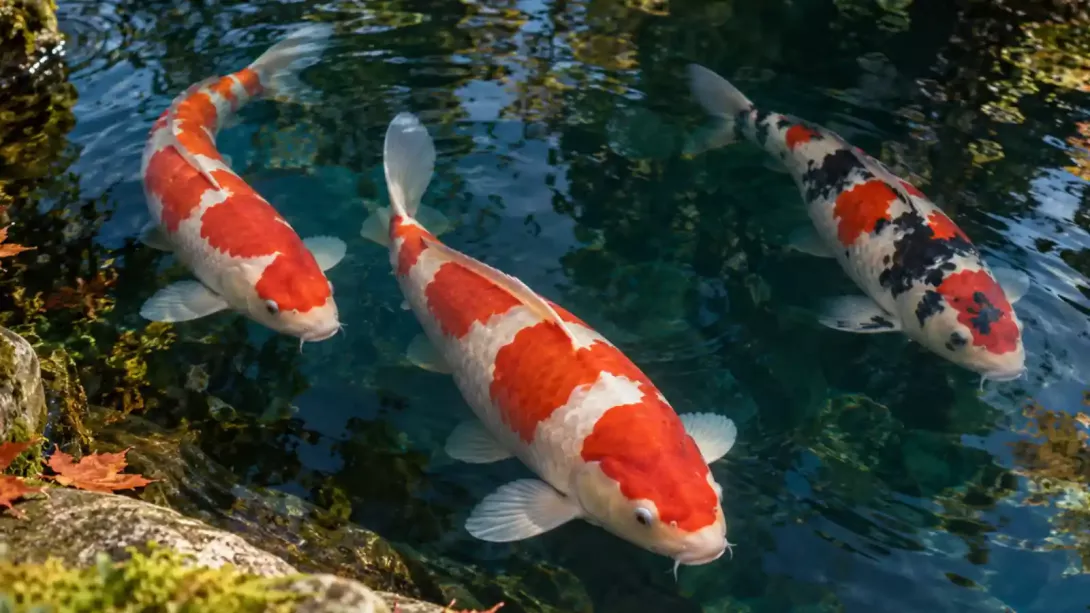
A sunny afternoon arrives, you walk toward the pond, and your koi gather at the edge. It feels like feeding time. But in autumn, the temperature beside your pond can tell a different story from the temperature inside it.
Astronomical fall began in the United States on September 22, 2026, at 7:05 p.m. Central Time, according to the National Weather Service. For owners of unheated outdoor koi ponds, this seasonal transition is a useful reminder to reassess feeding. Shorter days and cooling weather change pond conditions gradually, and the calendar alone cannot tell you when your fish need less food.
The practical concern is simple: a familiar summer feeding routine can become too generous as the water cools. Before giving your koi their next meal, check the pond temperature, their feeding response, and the water quality. Together, those observations are more useful than a warm weather forecast or fish gathering where you usually feed them.
Why warm autumn days can lead to feeding mistakes
Koi are ectothermic: their body temperature closely follows the surrounding water. Cooling changes their metabolism and food requirements. The Ornamental Aquatic Trade Association explains that pond-fish appetite and metabolism generally rise and fall with water temperature.
Your pond also responds differently from the air. Its volume, depth, exposure, and circulation affect how quickly it warms or cools. The U.S. Geological Survey describes temperature as a major influence on aquatic biological activity and water chemistry. For a koi keeper, the useful measurement is the water the fish actually occupy.
Consider an illustrative example: the afternoon air reaches 72°F, but the pond is still 49°F after several cold nights. Feeding according to the pleasant weather would ignore the conditions surrounding the fish. The opposite can happen, too: a chilly morning does not necessarily mean a large pond has already cooled below its feeding range.
This is why two neighbors can reasonably follow different autumn feeding schedules. One has a shaded, shallow pond; the other has a larger, sheltered system. Copying a date from someone else's calendar misses the measurement that matters.
When should you stop feeding koi in fall?
For healthy adult koi in an unheated outdoor pond, stopping supplemental feeding at about 50°F (10°C) is a conservative, commonly used approach. The St. Louis Water Garden Society recommends monitoring pond temperature and not feeding below 50°F. That also aligns with our existing fall koi care guidance.
However, 50°F is a husbandry guideline, not a switch that instantly turns digestion off. Recommendations differ: OATA suggests that it may be better to stop below 8°C, approximately 46°F. Food formulations and managed pond conditions also vary. Avoid treating a single number as proof that every meal above it is safe or every meal below it causes harm.
The following is a cautious decision guide for established, unheated ponds. Heated systems, fry, underweight fish, and koi recovering from illness need an individualized feeding plan.
| What you observe | Practical response |
|---|---|
| Water remains above 60°F (about 16°C), with active feeding and normal test results. | Feed to actual demand and the food's instructions. Recheck the routine as temperatures decline. |
| Water is between about 50°F and 60°F (10–16°C) and trending downward. | Reduce portions and frequency as appetite falls. Use a food intended for the measured temperature. |
| Water reaches about 50°F (10°C) or lower. | Use the conservative approach of stopping supplemental feeding. Continue observation and water testing. |
| Fish suddenly refuse food, breathe abnormally, or ammonia or nitrite is detected. | Pause feeding and investigate, whatever the temperature. |
A bag marked “spring and fall” does not remove the need to measure temperature or control portions. Read its temperature guidance before using it.
Your filter is part of the feeding decision
A meal affects more than the koi eating it. Fish excrete ammonia, and uneaten food adds waste as it breaks down. A functioning biological filter processes that nitrogen waste through microbial activity. Its capacity is influenced by temperature, oxygen, and other water conditions.
Oklahoma State University Extension warns that rapid warming can increase fish activity and feeding enough to overwhelm an aquatic system's bacteria with ammonia. Applied to a koi pond, the lesson is to avoid abruptly restoring a large summer ration during a brief warm spell.
Watch the system's response before increasing food. A pond that handled a particular ration in July should not automatically receive the same amount in October. Clear water is not evidence that the biological filter is keeping up.
There is another reason to avoid aggressive autumn filter cleaning: rebuilding biological capacity takes time. University of Florida IFAS guidance on recirculating systems notes that establishing a biofilter takes longer in cooler water. Preserve established biological media and maintain it according to the filter's instructions. Our koi pond filtration guide explains the different jobs of mechanical and biological filtration.
A five-minute routine before feeding
1. Measure and record the water temperature
Use a pond thermometer according to its instructions, with the sensing element submerged in a representative location. Avoid basing decisions on a sun-warmed edge or a reading taken immediately beside a heater outlet.
Record readings at a consistent time. During changeable weather, a morning reading and a pre-feeding reading help reveal what one afternoon measurement misses. A simple notebook is enough: date, temperature, food offered, feeding response, and anything unusual.
2. Observe before opening the food container
Spend a minute watching the pond undisturbed. Are the fish swimming normally? Is one separated from the group? Does their behavior change only when you approach? This builds a useful baseline instead of making every visit immediately about food.
3. Make each feeding an observation
When conditions support feeding, begin with a small amount and watch it being eaten. Stop when interest fades and remove leftovers. The Minnesota Water Garden Society's winter-care guidance specifically highlights uneaten floating food as a reason to stop cooler-weather feeding.
Check automatic feeders now. A timer cannot recognize that the fish ignored the previous portion. If several people feed the pond, agree on one routine and record meals so “just a little” does not happen three times.
4. Keep testing even as feeding decreases
Test ammonia and nitrite regularly, along with pH and carbonate hardness (KH). Aim for undetectable ammonia and nitrite. Use our koi pond water-quality guide to understand the readings.
UF/IFAS ammonia guidance recommends weekly testing and immediate checks when fish behavior or appearance changes. If ammonia appears, increase testing and reduce or stop feeding while correcting the cause. Interpret total ammonia alongside pH and temperature, which affect the proportion present as more toxic un-ionized ammonia.
Which changes are normal, and which need attention?
A gradual reduction in activity as water cools can be expected. A sudden change, an affected individual, or abnormal breathing deserves investigation.
- Gasping or persistent surface hanging: check aeration, circulation, and water quality promptly.
- Clamped fins, repeated rubbing, or erratic swimming: look beyond an assumption that the fish are simply cold.
- Sores, damaged fins, or unusual growths: seek a diagnosis rather than waiting for spring.
- Loss of balance or marked deterioration: obtain urgent help from an aquatic veterinarian.
Record the water readings and take a short video if possible. Those details are more useful for troubleshooting than “the pond looks fine.” Our koi health guide can help you organize observations, but behavior alone cannot identify a particular disease.
Four autumn mistakes to avoid
Trying to compensate with one large meal. A skipped feeding is not an instruction to double the next one. Return to the current conditions and feeding response.
Changing everything on the same weekend. Keep notes when adjusting food, cleaning filters, or changing circulation. Several simultaneous changes make an emerging problem harder to trace.
Letting leaves become another waste source. Feeding may be declining while organic debris is increasing. Virginia Cooperative Extension's winterizing guidance, reviewed in February 2026, emphasizes removing dead vegetation and preventing leaf accumulation. Empty skimmer baskets and remove debris before it builds up.
Assuming no food means no maintenance. Fish still need suitable water and oxygen after supplemental feeding stops. Plan winter circulation and freeze protection for your climate and equipment; stopping food does not by itself make a pond ready for ice.
The next meal starts with a measurement
Use the arrival of autumn to reset your routine: put the thermometer where you will use it, review the feeder, and start a temperature-and-feeding log. Let measured pond conditions guide each decision. A warm afternoon is a good reason to enjoy your koi; the water temperature and the pond's condition determine whether it is also a good time to feed them.