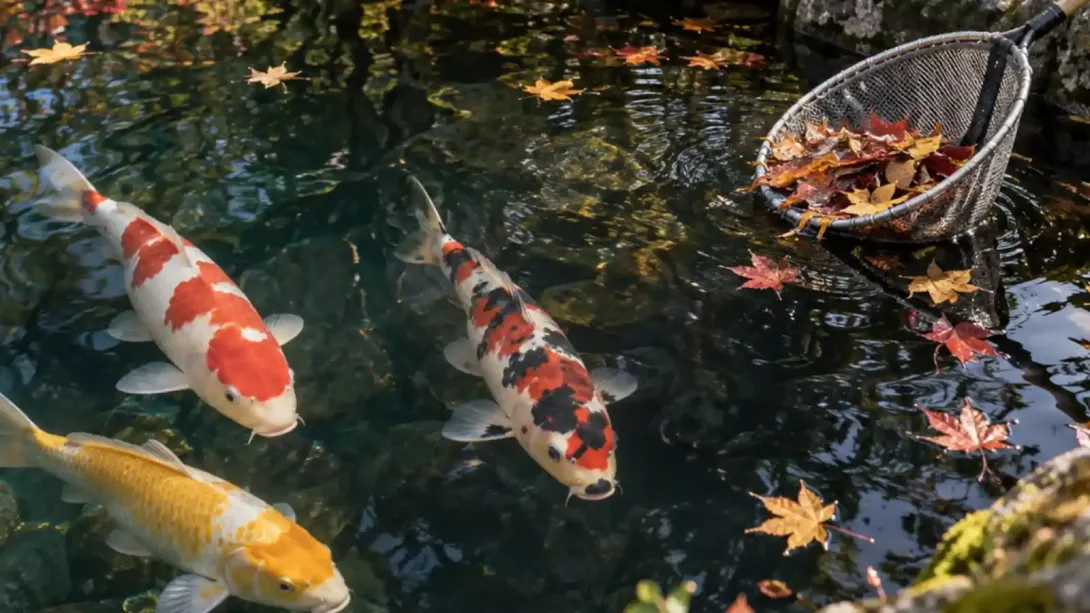
A red maple leaf drifting above a white-and-orange koi makes a beautiful autumn photograph. A season's worth of leaves collecting in the pond creates a different picture: more decaying material, more maintenance, and less room for mistakes with water quality.
As September 2026 moves into autumn across the northern United States, this is a useful moment to prepare for leaf fall. The Royal Horticultural Society's September pond guidance recommends netting where falling leaves are excessive and removing dying waterlily foliage. Your local trees and pond conditions determine the timing; a Minnesota pond and a Florida pond will not follow the same schedule.
For koi keepers, the seasonal task goes beyond keeping the surface attractive. Leaves can collect in skimmers, settle out of reach, and add to the waste already produced by your fish. The useful window is before heavy leaf fall and before floating debris becomes bottom sludge. You do not need a spotless pond. You need a manageable waste load and equipment that keeps working.
Why fallen leaves matter in a koi pond
Leaves become part of the pond's organic waste. Microorganisms breaking down dead plant material consume oxygen, alongside the fish and other pond life. University of Florida IFAS Extension explains that decaying organic matter can increase oxygen demand. Cooler water can hold more oxygen than warmer water, but that capacity does not guarantee that a particular pond has enough dissolved oxygen.
There is also a physical problem. Leaves caught in a basket or on a screen can restrict the flow on which your pond depends. A pump may still make noise while the return delivers much less water than usual. Inspecting the return is therefore more useful than simply listening for the pump.
Here is the koi-specific implication: a dedicated koi pond already handles a regular input of food and fish waste. Autumn leaves add another input, sometimes in a single windy afternoon. Removing them early reduces the extra work you are asking an existing filtration system to do.
One distinction matters: debris caught inside a filter has been collected, but it has not yet left the system. Emptying that basket or flushing the waste chamber completes the job. Our koi pond filtration guide explains how mechanical waste removal and biological filtration work together.
A few floating leaves are not an emergency
There is no useful universal rule such as “ten leaves are safe, but twenty are dangerous.” Pond volume, fish load, circulation, leaf accumulation, and maintenance all change the outcome. The RHS explicitly notes that a few fallen leaves are not a reason to worry.
Instead, look for a pattern. Are new leaves arriving faster than you remove them? Is a mat developing in one corner? Does the skimmer basket fill between checks? Are leaves disappearing from the surface because you collected them, or because they sank?
Two ponds beneath identical trees can need very different attention. A pond with an accessible skimmer and good waste collection may be easy to maintain. A pond with deep shelves, rock pockets, or awkward access may need more prevention. Choose your routine around the places where debris actually accumulates.
Five steps to take before the next heavy leaf fall
1. Catch leaves while they are easy to reach
If trees regularly drop leaves into your pond, install a purpose-made pond net before the busiest period. Support and secure it according to its instructions so collected leaves do not pull it into the water. Keep loose mesh away from fish, and inspect it for trapped wildlife.
Arrange the net so you can still inspect the koi and reach the skimmer. A cover that makes every check difficult is likely to become a maintenance obstacle. Where netting is impractical, make surface skimming part of your daily visit during leaf fall.
2. Check the whole route through the filter
Start at the skimmer or intake, then check accessible prefilters and the return. Remove collected leaves before they compact. During a windy spell, check again later rather than assuming yesterday's cleaning will last until the weekend.
Clean mechanical components as their manufacturer directs. Preserve biological media: avoid chlorinated tap water, drying, or an aggressive all-at-once clean. OATA's garden pond guidance recommends checking for blockages and using removed pond water when rinsing filter media.
3. Remove submerged debris without churning up the pond
Lift reachable leaves gently or use suitable pond-cleaning equipment. Work in manageable sections and watch the koi throughout. Avoid turning a routine tidy into a full drain, fish capture, and scrub simply because autumn has arrived.
If a deep accumulation releases foul-smelling water or the fish become distressed, stop disturbing it and get experienced help. A neglected pond may need a planned clean with appropriate fish holding facilities. That is a different job from removing this week's leaves.
4. Trim dying foliage and clear the pond edge
Remove collapsing waterlily leaves and other dead growth before it falls into the pond. Keep the immediate edge clear of piles that the next gust can blow back in. The RHS includes leaf exclusion and removal of dying foliage among its autumn pond tasks.
Check where a leaf blower sends material, too. Finishing the lawn by blowing debris toward the pond simply moves the cleanup to a harder place.
5. Record a water-quality baseline
Measure water temperature, ammonia, nitrite, pH, and KH, and note how the fish behave. A dated result gives you something to compare after heavy leaf fall, maintenance, or a change in feeding.
Aim for no detectable ammonia or nitrite in an established pond. KH helps you assess the water's buffering capacity. For interpretation and corrective steps, use our koi pond water-quality guide. Do not assume that clear water means the chemistry is safe.
Adjust feeding to the water temperature
The other autumn change happens inside the koi. Their metabolism and appetite respond to water temperature. OATA's pond-fish care guidance recommends adjusting food as the water cools and notes that feeding may be inappropriate below 8°C, about 46°F.
Specific food instructions and pond-management approaches differ, so use a pond thermometer and follow the temperature guidance for your koi feed. Do not treat one threshold as a biological switch that applies to every food, fish, and system.
Take readings at a consistent location and time, and watch the trend. A warm afternoon does not automatically justify a return to summer portions. Offer only what the koi readily eat and remove leftovers. Our koi care guide covers the broader feeding routine.
Feeding matters even when every pellet disappears. UF/IFAS explains that fish release ammonia as they metabolize food, and the microorganisms processing that waste need oxygen and alkalinity. Autumn feeding decisions should therefore consider both appetite and water-test results.
Warning signs that deserve immediate attention
Slower feeding as water cools can be expected. Labored breathing or several koi repeatedly gulping at the surface should not be dismissed as seasonal behavior.
- Surface gasping, especially early in the morning: low dissolved oxygen is one possible cause.
- Several fish suddenly gathering at a return: check oxygen, circulation, and water chemistry promptly.
- A sudden appetite loss: compare it with temperature and test results instead of assuming the fish are preparing for winter.
- Loss of balance, persistent flashing, sores, or isolation: investigate a health or environmental problem.
The Virginia Department of Wildlife Resources identifies early-morning gasping as a warning of oxygen trouble. If fish are gasping, immediately increase aeration and surface agitation with suitable equipment, check for blocked flow, pause feeding, and test the water. Do not delay aeration while searching for a test kit.
UF/IFAS recommends dissolved oxygen of at least 5 mg/L for fish health and emergency aeration below 4 mg/L. Treat those as action guidance, not a guarantee of safety at every reading. Oxygen often reaches its daily low before daybreak; an afternoon measurement can miss that low.
Breathing distress can also involve ammonia, nitrite, or gill disease. If distress persists or koi have visible injuries, contact a fish veterinarian. Our koi health guide can help you organize observations, but symptoms alone do not establish a diagnosis.
Does autumn pond turnover threaten backyard koi?
Turnover is a real process in ponds that develop separate water layers. Virginia DWR explains that mixing oxygen-poor bottom water into the upper layer can cause an oxygen problem.
The practical distinction for koi keepers is whether those layers exist. A continuously circulated backyard pond may not develop the persistent layering seen in a deeper, still pond. Do not label every autumn problem “turnover,” and do not assume every koi pond faces the same risk. Check circulation and measured conditions first.
Autumn mistakes worth avoiding
- Waiting until every tree is bare: remove debris throughout the season instead of allowing weeks of accumulation.
- Leaving a full net or basket in place: inspect collection points after windy weather.
- Shutting down life-support equipment by calendar: plan any winter changes around your climate, pond design, and continuing oxygen needs.
- Adding medication before checking water: record conditions and seek a diagnosis rather than treating a guess.
- Using a pond additive as a substitute for leaf removal: it does not empty the skimmer or collect the leaves for you.
Your next pond visit
Watch the koi before feeding. Check the temperature and return flow. Empty the leaf collection points, remove reachable debris, and record your water tests. Repeat the leaf and equipment checks after windy weather.
Autumn koi care starts before winter preparation: keep new waste manageable while maintaining stable conditions for the fish already in your pond. Catching leaves early is a small task that keeps the next task smaller, too.